 Mystical places in Nepal
3 legends · 2 cities
Regions and cities
Koshi Province3
By kind of place
All places
Khumjung and the Yeti Scalp
The conical russet scalp in the monastery at Khumjung was held by the Sherpas to have been taken from a yeti and kept as a relic. In 1960 Edmund Hillary's expedition was allowed to take it to Chicago, Paris and London for examination, against a deposit and in the company of a village elder. The verdict was unanimous: the scalp had been moulded from the hide of a serow, a goat-antelope common in the same mountains, and the direction of hair growth and the structure of the skin matched exactly. It was returned to Khumjung, where it still is.
Pangboche and the Yeti Hand
The monastery at Pangboche in the Khumbu kept a hand for centuries that the monks called a yeti's. In 1959 the expedition member Peter Byrne swapped several bones for human ones and smuggled the originals out — in the luggage of the actor James Stewart, by the usual telling. Tests over the years contradicted one another until 2011, when the University of Edinburgh sequenced what survived: human bone. The relic itself was stolen from the monastery in the nineties, and what remains of it is an ordinary human hand with somebody else's fingers attached.
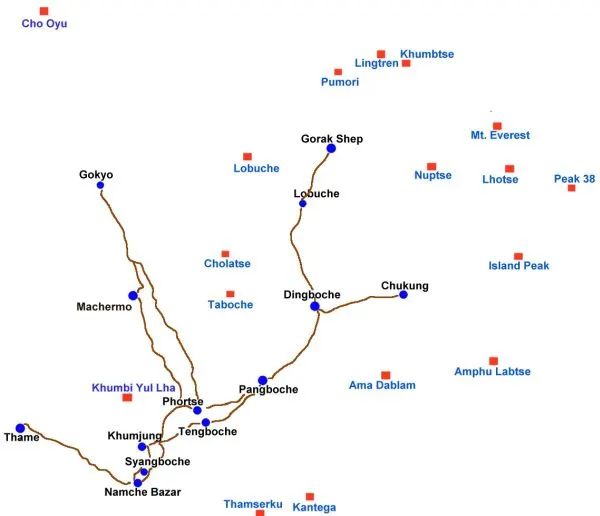
Khumbu, Yeti Country
The valley below Everest, home of the Sherpa, where Western expeditions first met the yeti as something more than a story. In 1951 Eric Shipton photographed a thirteen-inch print on the Menlung Glacier with an ice axe beside it for scale — the picture is still argued over. Khumjung monastery keeps a scalp said to be a yeti's; analysis in 1960 found it was made from serow hide.