The Beale Ciphers
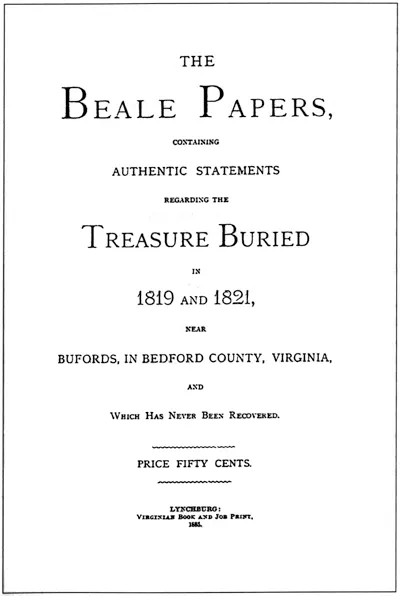
Bedford County and the city of Lynchburg in Virginia, USA, form the geographic core of one of the most famous cryptographic mysteries in American history. In 1885, an anonymous pamphlet surfaced containing three coded texts purporting to reveal the exact burial site of an enormous cache of gold, silver, and jewels buried in the 1820s by an adventurer named Thomas J. Beale.
The legend
Danger Level: Yellow (No paranormal physical danger, but obsession caused financial ruin, trespassing, and arrests) According to lore, in 1817 a company of thirty frontiersmen led by Thomas J. Beale discovered an immense gold and silver deposit north of Santa Fe. After mining thousands of pounds of bullion, Beale transported the hoard to Virginia, burying it in an iron-lined vault four miles from Buford's Tavern. In 1822, Beale entrusted an iron box containing three numerical ciphertexts to Lynchburg innkeeper Robert Morriss, instructing him to open it only if Beale failed to return within ten years. The promised decryption key never arrived. Decades later, an unnamed friend managed to decipher the second text using the United States Declaration of Independence as a book cipher, detailing a buried fortune now valued at over $60 million. The first cipher (giving the exact coordinates) and the third (listing the owners and heirs) remain unsolved, driving generations of treasure hunters into frantic searches across the Virginia foothills.
What actually happened?
Prominent cryptanalysts, including legendary NSA cryptologist William F. Friedman, and linguistic researchers widely conclude that the Beale Ciphers are a 19th-century literary hoax. Textual and stylistic analyses conducted by linguists revealed that the letters attributed to 1820s frontiersman Thomas Beale share identical vocabulary, rhythm, and sentence structures with the author of the 1885 pamphlet, James B. Ward (who registered the original copyright). Key vocabulary words used in the letters were not in common American usage until decades after 1822. Furthermore, statistical analysis indicates that Ciphers 1 and 3 lack the frequency distribution of meaningful English plaintext and are almost certainly fabricated random sequences. The 1885 booklet was sold for 50 cents per copy, serving as a lucrative dime-novel-style commercial venture exploiting frontier treasure romanticism.
History
The mystery formally began with the 1885 publication of the pamphlet "The Beale Papers" by the Virginian Book and Job Print office in Lynchburg. Throughout the 20th century, the pursuit of the buried gold turned into an obsessive crusade: searchers blasted hillsides with dynamite, excavated private farms around Montvale with backhoes, and organized the Beale Cypher Association in the 1960s to attack the codes using early mainframe computers. Local landowners continue to battle trespassers, while the ciphers themselves have become a staple study in cryptographic history, analyzed alongside the Voynich Manuscript and the Kryptos sculpture.
Where is it?
Bedford County and the City of Lynchburg, Virginia, USA; primarily centered around the community of Montvale (historic site of Buford's Tavern along modern Route 460) in the Blue Ridge foothills.
Can you visit?
Yes, the towns of Lynchburg and Montvale are public and fully accessible via major highways. However, the foothills, pastures, and forests where the treasure was allegedly buried are private property. Metal detecting, unauthorized excavation, or trespassing on residential and farm lands is strictly prohibited under Virginia property laws and actively enforced by local law enforcement.
Kathleen Goligher and the Belfast Circle
From 1914 the Belfast engineer William Jackson Crawford studied the Goligher family circle and wrote three books about the psychic rods with which sixteen-year-old Kathleen raised the table; he weighed her, photographed her by red light and worked out an entire mechanics. After Crawford's death in 1920 the physicist Edmund Edward Fournier d'Albe took over the circle. He sat twenty times and published his report: the ectoplasm in the photographs was ordinary white cloth hanging from under her skirt, and Kathleen lifted the table with her foot, which he once saw plainly. She was not seen in public again.
Comments
No comments yet. Be the first.