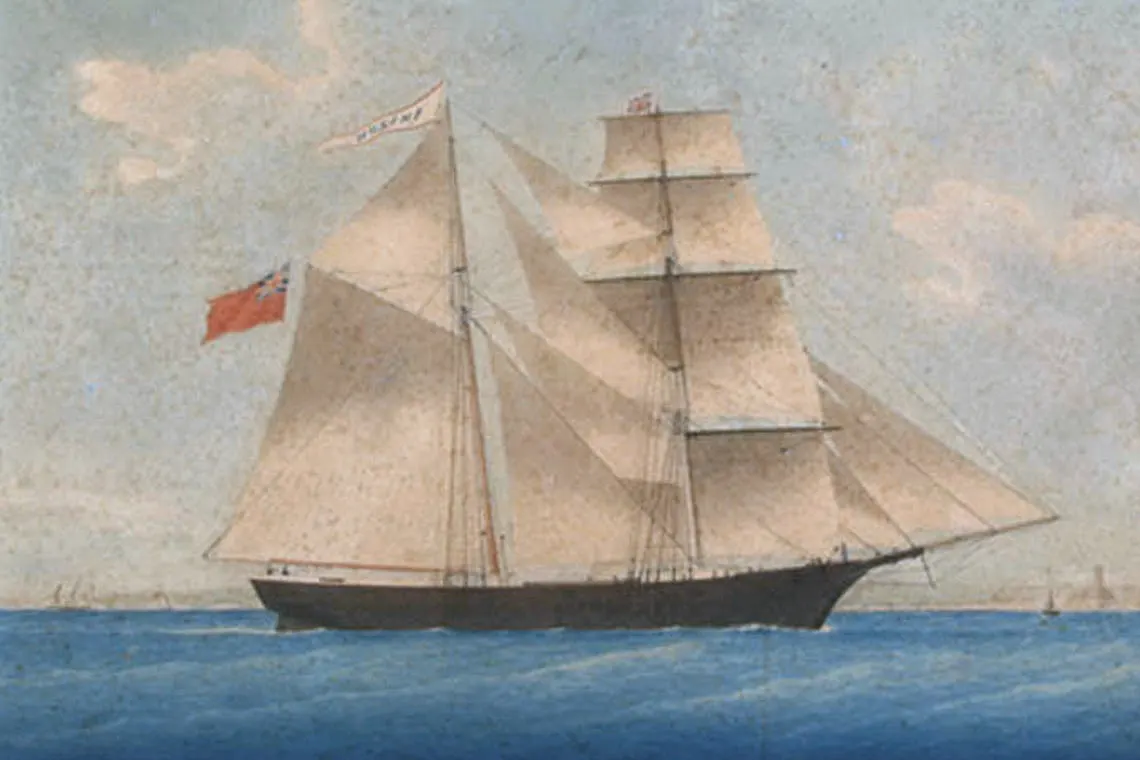
The Mary Celeste at Gibraltar
The Port of Gibraltar and the historic Gibraltar Vice-Admiralty Court represent the focal point of the greatest maritime mystery of the 19th century: the saga of the brigantine Mary Celeste. In December 1872, the derelict "ghost ship" was towed into Gibraltar Harbour, where an exhaustive British maritime inquiry took place, laying the groundwork for countless nautical legends and modern conspiracy lore.
The legend
Danger Level: Yellow (An enduring maritime mystery that triggered wild speculation, but poses no modern physical threat) According to widespread folklore, boarding crews from the Canadian vessel Dei Gratia found the Mary Celeste completely frozen in time: hot tea was still steaming in cups, warm breakfast sat untouched on the mess tables, unsmoked pipes lay beside open books, and the captain's wife's sewing machine stood with unfinished fabric. Yet not a single soul—Captain Benjamin Briggs, his wife, infant daughter, and seven crewmen—remained aboard, while the longboats allegedly remained untouched in their davits. Popular lore attributed the total disappearance to attacks by giant squids, alien abduction, the Bermuda Triangle, or sudden collective psychosis causing the entire crew to leap overboard into the Atlantic.
What actually happened?
Virtually all paranormal details (warm tea, smoking pipes, intact lifeboats, and the spelling "Marie Celeste") were purely fictional inventions by young Arthur Conan Doyle in his 1884 short story "J. Habakuk Jephson's Statement," which contemporary newspapers misreported as genuine fact. In reality, the ship's single yawl boat was completely missing, the binnacle compass was destroyed, navigation instruments and ship papers were gone, and three feet of water sloshed in the hold. The ship was transporting 1,701 barrels of industrial alcohol. Under fluctuating temperatures, nine porous red oak casks leaked, filling the unventilated hold with volatile, expanding alcoholic vapor. Facing what sounded like a catastrophic sub-deck combustion rumble, Captain Briggs panicked, believing an explosion was imminent. He ordered the crew and family into the trailing yawl, linked to the main vessel by a long towline. A sudden Atlantic squall severed the line; the overburdened small boat foundered in the open sea, while the trimmed, buoyant brigantine drifted harmlessly ahead until spotted by the Dei Gratia.
History
The Mary Celeste sailed from New York bound for Genoa in November 1872 and was encountered derelict on December 4, 1872, roughly 400 miles east of the Azores. When the crew of the Dei Gratia brought the prize into Gibraltar, the crown prosecutor, Frederick Solly-Flood, aggressively pursued a criminal theory of piracy, crew mutiny, and insurance fraud. Following months of forensic examinations and chemical testing on red stains (which proved to be mineral varnish and rust rather than blood), the Vice-Admiralty Court dismissed the criminal charges and awarded a partial salvage payment. Regarded as an unlucky ship by sailors, the brigantine changed hands repeatedly before being deliberately wrecked on a reef off the coast of Haiti in 1885 during a fraudulent maritime insurance scheme.
Where is it?
Gibraltar (British Overseas Territory); the historic anchorage waters of the Port of Gibraltar, Waterport Wharf, and the Supreme Court of Gibraltar building along Main Street where the maritime inquiry took place.
Can you visit?
Yes, Gibraltar is an open, globally accessible territory reached via international flights, cruise liners, or the land border from La Línea, Spain. The harbor walkways, historic wharves, and city center surrounding the court complex are fully open to the public. The Gibraltar National Museum preserves documents and period context relating to the 1872–1873 admiralty proceedings.
The Letters from Ummo
From 1966 Spanish ufologists received typewritten letters from the inhabitants of the planet Ummo, in the system of the star Iumma: hundreds of pages on physics, society and language, each marked with an emblem of three strokes. The correspondence ran for twenty years, produced a literature of its own and several religious groups, and was cited as the most detailed extraterrestrial message on record. In 1993 the Madrid psychologist José Luis Jordán Peña publicly stated that he had written them himself, as a social experiment in what educated people are prepared to believe. The typewriter, the Spanish syntax and the scientific errors of the sixties all matched his authorship.
Comments
No comments yet. Be the first.