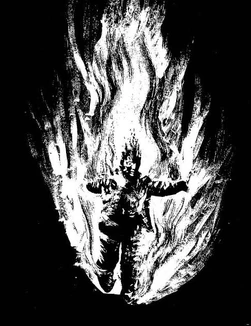
The Char Man of Ojai
The Ojai Valley in Ventura County, southern California, United States—specifically the shaded, winding rural corridor of Creek Road and the adjacent Camp Comfort Park in the Topatopa Mountains foothills. "Char Man" (or Char-Man of Ojai) is one of California's most enduring roadside urban legends, emerging in the mid-20th century against the backdrop of recurrent, devastating chaparral brushfires in the region.
The legend
Danger Level: Green (Harmless roadside adolescent folklore and camp horror trope posing zero physical danger) The origins of the entity are attributed to a catastrophic brushfire (most commonly the 1948 fire). A father and son (or husband and wife) were trapped by advancing flames inside a remote timber cabin within the Ventura River canyon. The man plunged through the firestorm to save his family, suffering catastrophic full-body burns while his loved ones perished before his eyes; the physical trauma and grief shattered his sanity. Escaping into the wilderness prior to first responders' arrival, the disfigured survivor became a reclusive feral phantom. Lore claims that he haunts the shadows along Creek Road: a hairless, earless figure covered in soot, peeling skin, and rotting dressings, radiating an odor of sulfur and scorched meat. Local teenage legend dictates that if a motorist idles on the bridge near Camp Comfort late at night with lights extinguished, the creature charges from the sycamores, leaps onto the car hood, claws frantically at the glass, and attempts to flay the driver's face to graft new skin onto his own charred flesh.
What actually happened?
Historical scrutiny by the Museum of Ventura County and regional folklorists proves that Char Man is a textbook example of suburban American legend-tripping: The trauma of wildfire seasons: The Ojai basin is surrounded by the chaparral-covered ridges of the Los Padres National Forest. Driven by seasonal Santa Ana winds, wildland fires spread with devastating speed (e.g., the 1948 Wheeler Fire, Matilija burns, and the 2017 Thomas Fire). The destruction of rural ranches generated chronic community anxiety, causing local culture to anthropomorphize the wildfire threat into a vengeful, scorched boogeyman. Optical topography of Creek Road: Creek Road serves as a rural bypass connecting Ojai to coastal Ventura. It is an unlit, narrow, winding two-lane corridor running beneath massive canopy oaks and western sycamores. Sweeping headlights interacting with low-hanging boughs, fluttering leaves, and wandering wildlife trigger acute pareidolia, routinely misinterpreted by drivers as a crouched humanoid figure. Campfire pranks and youth dares: Camp Comfort has hosted scout camps, teen bonfires, and evening parties since the mid-20th century. Older youths initiated peers into the myth, hiding in the riparian brush by the bridge to ambush idling vehicles by banging violently on car panels, physically simulating the monster to perpetuate the legend. Zero forensic records: Ventura County Sheriff's Department archives preserve no records of attacks by a burned hermit, nor any evidence of unidentified wild dwellers along the creek. Unlike the Green Man of Pennsylvania (which was based on a real, gentle burn survivor named Raymond Robinson), Char Man is a fabricated urban spook story.
History
The earliest documented oral variants began circulating among Ventura County high schoolers in the early 1950s, following the intense regional fire cycles of the late 1940s. Throughout the 1960s and 1970s, the narrative gained cinematic horror tropes such as skin-harvesting and roof-slamming attacks. In the late 1990s and early 2000s, the lore was formally cataloged in regional folk anthologies like Weird California and early internet paranormal bulletin boards. During the 2010s, the story inspired independent horror media (including the 2019 found-footage film Char Man), cementing Creek Road as one of Southern California's classic haunted drives.
Where is it?
Ventura County, California, United States; situated within the Ojai Valley along Creek Road as it follows San Antonio Creek, centered around Camp Comfort Park roughly 2 miles south of downtown Ojai.
Can you visit?
Yes, Creek Road is an active, paved public thoroughfare open 24/7. Camp Comfort Park is an official Ventura County recreational park offering reserved campsites and day-use picnic facilities, open daily from 07:30 to sunset (registered overnight campers have continuous access). Real-world safety considerations involve vehicle navigation: Creek Road has numerous blind curves, lacks pedestrian sidewalks, and has no artificial streetlights, making night parking along the narrow shoulders an auto collision hazard. Visitors must respect private property lines (adjacent ranches are fenced and protected under California trespassing laws) and strictly obey municipal fire safety ordinances during high fire-danger seasons.
Island of the Dolls
An islet in the Xochimilco canals near Mexico City, hung with salvaged dolls for half a century. Its caretaker said he hung them to appease the spirit of a drowned girl; after his death in 2001 it became a tourist pilgrimage.

Comments
No comments yet. Be the first.