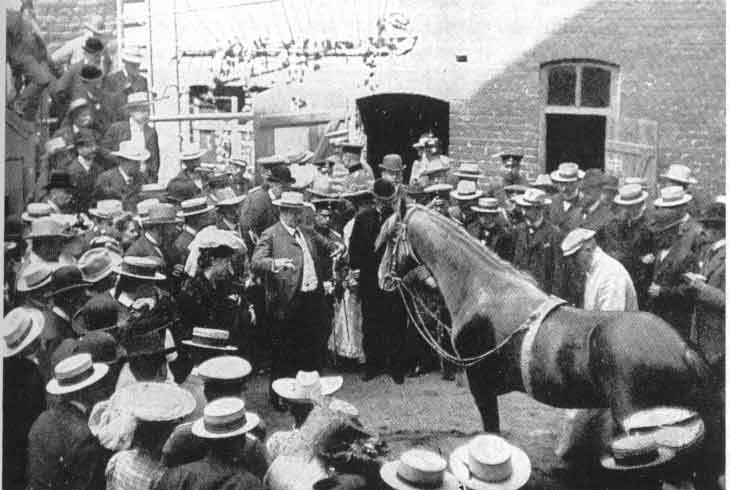
Clever Hans
The residential inner courtyard at 10 Griebenowstraße in the Mitte district of Berlin, Germany. At the turn of the 20th century, this urban setting hosted public demonstrations of the Orlov Trotter stallion known as Clever Hans (Der Kluge Hans). The horse's apparent mastery of arithmetic and human language captivated international audiences, revolutionized animal cognition research, and led to the discovery of the observer-expectancy effect ("Clever Hans effect").
The legend
Danger Level: Green (A historic psychological phenomenon and honest scientific misattribution posing zero physical danger) Between the 1890s and 1900s, retired Berlin mathematics teacher Wilhelm von Osten presented an Orlov Trotter stallion that apparently possessed human-level cognitive faculties. Hans reportedly performed addition, subtraction, multiplication, and fraction calculations, read analog clocks, identified calendar dates, recognized musical tones, and spelled out German words. The horse answered by tapping his right front hoof on a wooden platform (striking three times for "3" or tapping sequential numbers corresponding to an alphabet chart). The stallion answered accurately even when questioned by unfamiliar guests in von Osten's absence. In September 1904, the official 13-member "Hans Commission"—comprising prominent zoologists, physiologists, zoo directors, and circus trainers led by philosopher Carl Stumpf—formally declared that no trickery, sleight of hand, or fraud was present. International headlines proclaimed the stallion an epochal discovery proving abstract rational thought in non-human animals.
What actually happened?
The demystification of Clever Hans became a foundational milestone in experimental psychology through the rigorous methodology of German biologist and psychologist Oskar Pfungst, working within Professor Carl Stumpf's laboratory. In 1907, Pfungst executed a series of controlled blind trials establishing: Isolated knowledge testing (blind protocol): When questions were displayed so that no human present in the yard knew the solution, Hans's accuracy plummeted from 89% to roughly 6% (chance level). Visual occlusion testing: When blinders were fitted to Hans or the questioner stood outside his visual field, the horse could no longer produce correct answers. Involuntary micro-visual cues: Pfungst proved Hans possessed no arithmetic ability, but rather exceptional observational sensitivity. When posing a problem, human observers leaned forward slightly and tensed their posture while watching the hoof. As the count reached the correct sum, observer tension peaked; upon hitting the target number, the human inevitably made an involuntary, sub-millimeter upward head movement or postural relaxation. This microscopic cue signaled the horse to stop tapping and collect his food reward. Scientific legacy: Wilhelm von Osten was not a con artist; he genuinely believed in the horse's cognitive abilities and transmitted cues without conscious intent. Pfungst's work revealed that an investigator's expectations can alter subject behavior, prompting the establishment of double-blind protocols across experimental psychology, biology, and clinical medicine.
History
Wilhelm von Osten purchased the stallion in 1900, spending years attempting to educate him using chalkboards, counting beads, and standard school primers. Following Pfungst's 1907 findings, an offended von Osten severed relations with the academic community, insisting on the authenticity of the horse's mind until his death in 1909. Hans was subsequently transferred to wealthy manufacturer Karl Krall, who extended the training experiments in Elberfeld ("Elberfeld horses"). Following the outbreak of World War I in 1914, Clever Hans was requisitioned by the Imperial German military as a draft animal and died in service, presumably around 1915 or 1916.
Where is it?
10 Griebenowstraße, Mitte District, Berlin, Germany; inside the paved residential courtyard of a late-19th-century tenement building. The academic archival legacy is preserved at the Institute of Psychology at the Humboldt University of Berlin.
Can you visit?
Yes, Griebenowstraße is a public residential street in central Berlin, situated near Rosenthaler Platz and the Rosenthaler Platz U-Bahn station (line U8). The neoclassical facade of building number 10 is freely accessible from the public sidewalk at any time. The interior courtyard (Hof), which housed the original stables and demonstration platform, is private residential property secured by locked gates, though it can be viewed through the entryway archway when open. Archival files of the 1904 commission, Carl Stumpf's correspondence, and original copies of Pfungst's monograph are preserved in the library collections of the Humboldt University of Berlin.
Petit-Rechain and the Belgian Triangle
The photographic centrepiece of the Belgian wave of 1989–90: a black triangle with a light at each corner and one in the middle, taken at Petit-Rechain near Verviers in April 1990. It went round the world, was analysed at the University of Mons and the Royal Military Academy, and produced expert talk of plasma and of an image impossible to fake. In July 2011 Patrick Maréchal went on RTL-TVI and showed how he had done it: a piece of polystyrene painted black, four spotlights and a long exposure. He had kept it to himself for twenty-one years because the joke had got away from him.
Comments
No comments yet. Be the first.