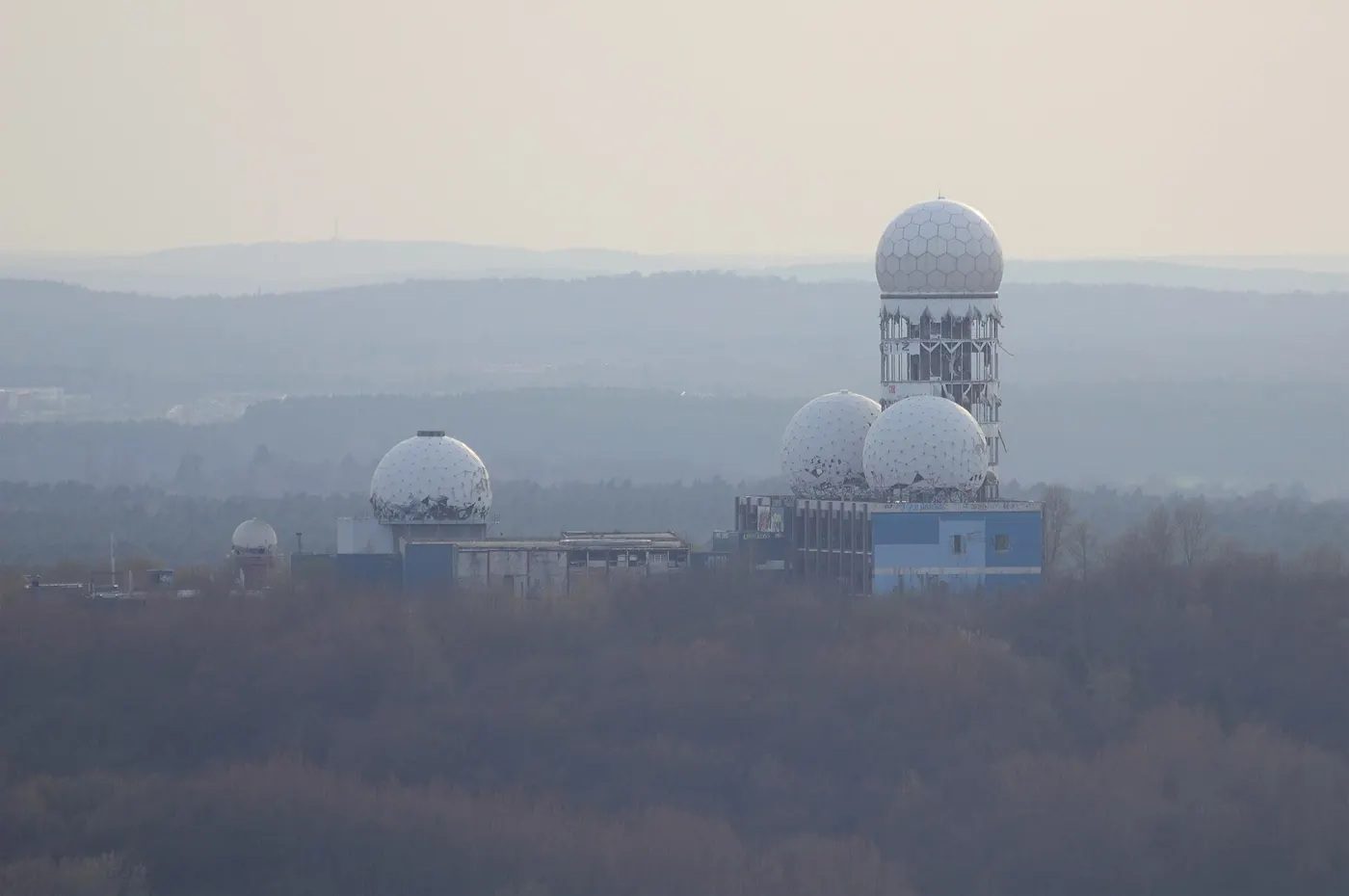
Teufelsberg
Teufelsberg ("Devil's Mountain") is an artificial hill rising 120.1 meters above sea level within the Grunewald forest in the Charlottenburg-Wilmersdorf borough of western Berlin, Germany. Engineered after World War II from roughly 26 million cubic meters of urban rubble piled directly atop the shell of an unfinished Nazi military-technical faculty, the summit became the location of "Field Station Berlin"—a classified Cold War signals intelligence (SIGINT) listening outpost operated by the US National Security Agency (NSA) and British intelligence. Crowned by weathered white geodesic radomes, the site stands as an iconic architectural monument to Cold War espionage and one of Europe’s premier open-air street art galleries.
The legend
Danger Level: Yellow (Legitimate structural hazards of an abandoned military radar complex: unbarricaded edges, open utility shafts, fractured masonry, and darkness romanticized into espionage myths) Teufelsberg has accumulated a dense mythology spanning occult conspiracies and Cold War urban legends: Subterranean Nazi laboratories: Regional urban lore alleges that buried beneath the rubble mound lies an intact, multi-level fortress containing Ahnenerbe esoteric laboratories and Adolf Hitler’s classified emergency bunkers. Speculative accounts claimed the subterranean halls concealed Reichsbank gold reserves, technical schematics for advanced Wunderwaffe prototypes, and sealed occult artifacts. Psychotronic warfare and ECHELON: During the height of the Cold War, local rumors held that the massive geodesic radomes were not merely passive intercept antennas, but experimental psychotronic transmitters broadcasting targeted microwave frequencies across the Berlin Wall to destabilize East German morale and induce neurological fatigue in Soviet military brass. Trans-border subterranean tunnels: Espionage mythology maintained that deep shafts beneath the listening station connected to a covert tunnel network that traversed beneath the Berlin Wall, leading toward Soviet military headquarters in Wünsdorf or linking directly to the subterranean labyrinths of Tempelhof Airport. Electromagnetic anomalous dead zones: Modern occultists characterize the summit as an acoustic and geomagnetic anomaly, linking its name to demonic forces associated with the adjacent Lake Teufelssee, citing compass drift, sudden smartphone battery drains, and disembodied radio chatter echoing inside the acoustic radomes.
What actually happened?
The documentary record of Teufelsberg reveals an extraordinary civil engineering endeavor and a critical operational chapter of Cold War SIGINT: The Nazi Military-Technical Faculty: In 1937, as part of Adolf Hitler and Albert Speer's monumental plan to transform Berlin into Welthauptstadt Germania, ground broke on the faculty of military technology (Wehrtechnische Fakultät). By 1940, massive reinforced-concrete foundations were cast before wartime resource diversion halted construction. In late 1945, Allied demolition teams attempted to blast the subterranean structure, but the dense military-grade concrete resisted demolition; leveling it with explosives risked collateral shockwave damage across western suburbs. Creation of the Trümmerberg: West Berlin municipal authorities resolved to entomb the bunker complex beneath wartime debris. Between 1950 and 1972, up to 800 dump trucks arrived daily, depositing 26 million cubic meters of sorted rubble salvaged from roughly 15,000 destroyed Berlin structures (representing one-third of the city's ruined building stock). Technicians capped the mound with topsoil and planted over one million trees, creating an artificial summit that served as West Berlin's highest elevation. Field Station Berlin Operations (USM-620J): In the early 1960s, Western intelligence recognized the hill's geographic value: towering over the North German Plain, it provided uninhibited line-of-sight electronic surveillance directly into the Soviet occupation zone. The US Army Intelligence and Security Command (INSCOM), the NSA, and Britain’s GCHQ erected Field Station Berlin. Housed beneath pressurized fiberglass radomes, directional microwave arrays captured Warsaw Pact tactical transmissions, microwave relay telecommunications, air-traffic telemetry, and encrypted military broadcasts across East Germany and western USSR sectors. Acoustics of the upper radome: The iconic central dome atop the multi-story tower exhibits extreme acoustic reflection. The spherical dielectric skin generates an acoustic decay time (reverberation) lasting up to 8 to 10 seconds. Low-frequency ambient noises, exterior drafts, and footsteps undergo constructive sonic interference, focusing localized echoes that visitors routinely mistake for disembodied voices.
History
Allied intelligence deployed temporary mobile surveillance units to the plateau in 1961, shortly following the erection of the Berlin Wall. By 1963, permanent multi-story listening blocks, antennas, and geodesic radomes were constructed, operating under continuous security upgrades throughout the Cold War. Following the fall of the Berlin Wall in November 1989 and the collapse of the Warsaw Pact, the facility became obsolete; by late 1991, American and British detachments stripped proprietary cryptologic gear and formally vacated the installation. During the late 1990s, a private investment syndicate acquired the parcel with plans to construct luxury hotels, conference centers, and restaurants. The development collapsed due to financial insolvency and environmental zoning lawsuits, leaving the facility abandoned to salvagers and graffiti artists. In the 2010s, new site managers repositioned the ruin into a curated international street-art destination, inviting muralists to cover the concrete surfaces. In 2018, the Berlin Senate formally designated Teufelsberg as a protected historical monument (Denkmalschutz).
Where is it?
Federal State of Berlin, Germany; Charlottenburg-Wilmersdorf district, situated inside the Grunewald forest park directly west of Lake Teufelssee and south of the Heerstraße thoroughfare (B2/B5), roughly 11 kilometers west of the Brandenburg Gate.
Can you visit?
Yes, the grounds are commercially accessible as an open-air street art museum and historic observation outpost. Admission requires an entry ticket purchased at the front perimeter checkpoint or online. Self-guided exploration allows visitors to walk through the central compound, view international murals, and climb the primary stairwell to the main geodesic dome platform overlooking the Berlin skyline. Visitor safety directives apply: The facility remains a stabilized industrial ruin: interior stairwells and back rooms can be unlit (carrying a flashlight is recommended), and floors may contain loose gravel or glass debris; Leaning over damaged exterior parapets, scaling exterior scaffolding, or trespassing into sealed utility shafts is strictly prohibited; Public transit access is serviced by the Berlin S-Bahn (lines S3 or S9 to Heerstraße station, or S7 to Grunewald), followed by a 25-to-35-minute pedestrian uphill hike along forested trails.
Beelitz-Heilstätten
A vast hospital complex outside Berlin, built around 1900 for tuberculosis patients. A wounded Hitler was treated here in 1916; parts of the site have stood empty since the 1990s and are green inside.
Comments
No comments yet. Be the first.