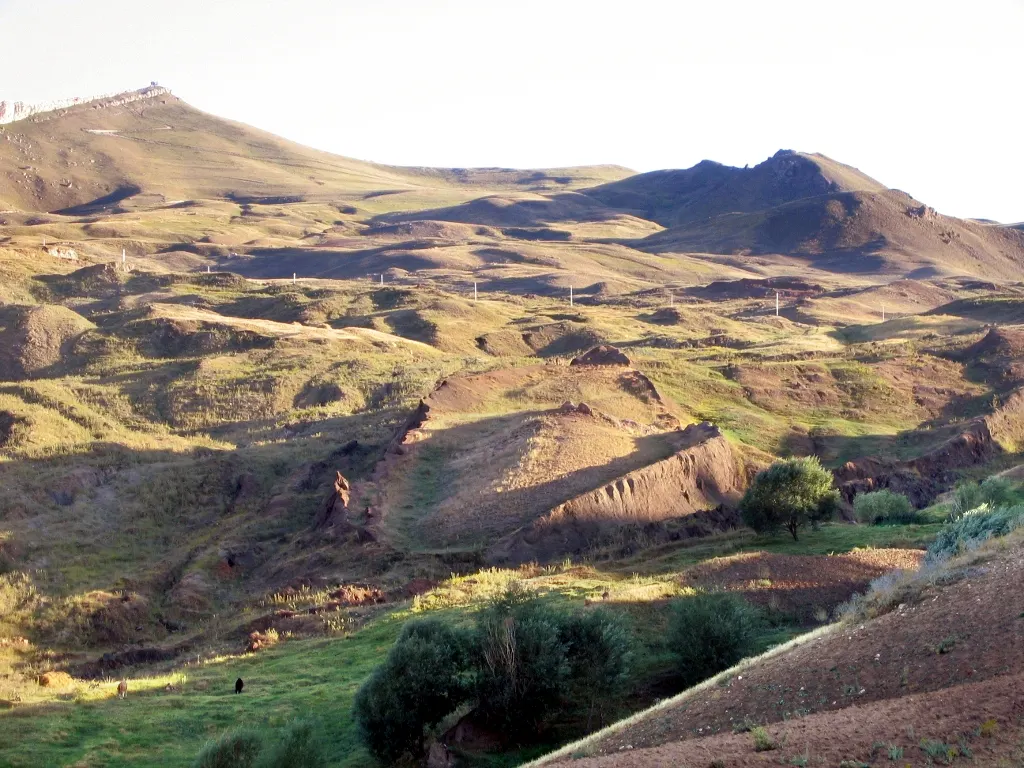
The Durupınar Formation, the Ark
The Durupınar site is a natural geological formation resembling the hull of a massive ship, roughly 160 meters (538 feet) long, situated in the Tendürek Mountains of eastern Turkey. Located 30 kilometers south of Mount Ararat, the outcrop has been promoted for decades by creationists and alternative theorists as the petrified remains of Noah's Ark.
The legend
Danger Level: Green (A real location with no recorded harm to visitors) Creationists and fringe researchers assert that the formation's dimensions match the biblical specifications of Noah's Ark in Genesis (300 cubits). According to popular lore, petrified wooden bulkheads, multiple levels, and animal pens remain preserved beneath the dirt, with enthusiasts claiming that metal detectors and radars revealed symmetrical lines of iron alloy rivets and fossilized timbers.
What actually happened?
The site is entirely a natural geological formation shaped by differential erosion. Comprehensive geological investigations and deep core drilling (notably led by geologists Lorence Collins and Murat Avcı) proved the structure to be an eroded syncline—an upended fold of native basalt, mudstone, and limestone exposed within an active mudflow. Laboratory assays detected zero petrified wood, and the alleged "metal rivets" are oxidized volcanic nodules of magnetite and limonite.
History
The site was spotted in 1959 by Turkish Air Force Captain İlhan Durupınar while examining aerial survey photographs for NATO mapping. Throughout the 1970s and 1980s, amateur archaeologist Ron Wyatt turned the site into an international sensation through sensationalized media campaigns. In 1987, the Turkish government officially designated the area a national park and erected a visitor overlook.
Where is it?
Doğubayazıt district, Ağrı Province, eastern Turkey, on the slopes of the Tendürek Mountains, approximately 3.5 km southeast of Üzengili village and 3 km north of the Iran–Turkey border.
Can you visit?
Yes, the location is accessible year-round. It is reached via rural roads from the town of Doğubayazıt. An observation platform and the Noah’s Ark Visitor Center overlook the formation, and footpaths allow visitors to hike directly around the perimeter of the stone formation.
Eusapia Palladino at Columbia
For twenty years the Neapolitan medium Eusapia Palladino lifted tables and materialised hands in front of the best scientists in Europe, and some of them went home convinced. Her method never varied: in the dark she substituted one hand or foot for another among the people controlling her, freeing a limb. The Cambridge sittings of 1895 showed it, and the matter was closed in New York in 1910, when investigators from Columbia University hired two conjurors. They took turns lying under the table and watched, in the dark, her foot come out of its shoe and brace against the leg. The report was printed in full and the American tour ended there.
Comments
No comments yet. Be the first.