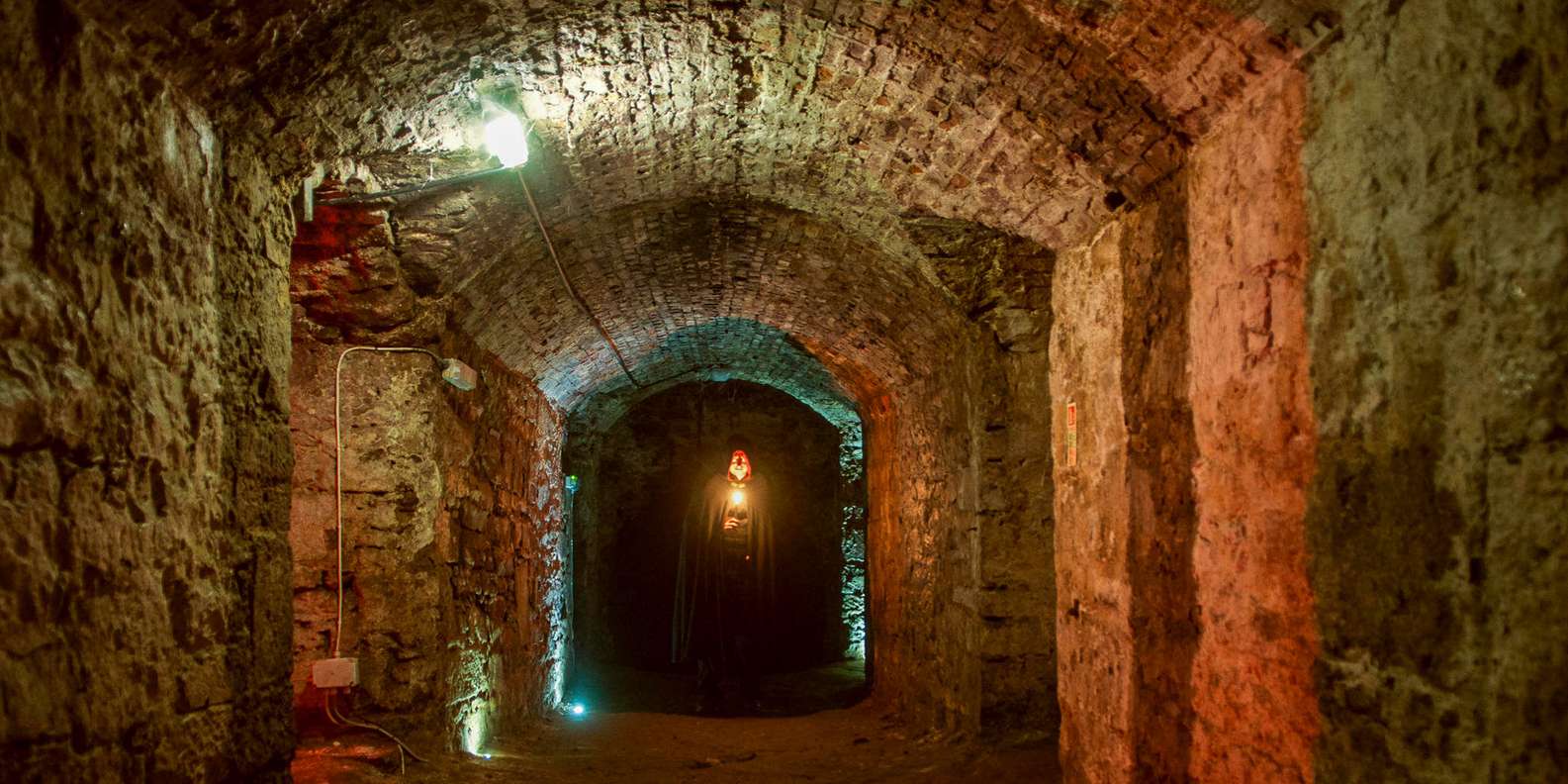
The Edinburgh Vaults
The Edinburgh Vaults (commonly known as the South Bridge Vaults) are an extensive subterranean labyrinth comprising approximately 120 stone chambers integrated inside the 19 massive masonry arches of the South Bridge viaduct in the Old Town of Edinburgh, Scotland, United Kingdom. Completed in the late 18th century to span the steep Cowgate ravine, the interior chambers were originally engineered as commercial storerooms and workshops. Rapidly rendered unlivable by catastrophic water infiltration, the vaults devolved into notorious subterranean slums, were abandoned and sealed in the mid-19th century, and lay forgotten for over a century. Since their rediscovery in the 1980s, the complex has gained international infamy as one of Europe's most prominent paranormal and dark-tourism hotspots.
The legend
Danger Level: Yellow (Legitimate subterranean environmental hazards: high humidity, airborne fungal spores, slick flagstones, and total sensory deprivation commercialized into a ghost realm) Across modern dark tourism and folklore, the Edinburgh Vaults are celebrated as one of the most haunted subterranean locations in the British Isles. Guides and supernatural media attribute the damp arches to several recurring phantoms: "Mr. Boots"—the aggressive entity of a tall, bearded man in heavy riding boots whose footsteps allegedly echo through empty corridors, blamed for shoving visitors, seizing personal items, and whispering threats into the ears of stragglers; "Jack"—the child spirit of a barefoot street urchin reported to tug on visitors' coats, hold hands, or flick pebbles in the dark; "The Watcher / The Black Entity"—a malevolent shadow residing in a chamber featuring a Wiccan stone circle, reputedly inducing nausea, sudden syncope, intense burning sensations, and unexplained bodily scratches on tourists trespassing across the threshold. Urban lore also links the vaults to the notorious 1828 bodysnatcher murderers William Burke and William Hare, claiming they stalked and butchered victims inside the underground drinking dens and stored decomposing corpses within the masonry vaults before delivering them to Dr. Robert Knox's anatomy school. Other rumors allege clandestine brothels, unlicensed distilleries, and plague victims sealed alive inside the walls.
What actually happened?
Archival city council minutes, surviving structural elevations by engineer Alexander Laing, and controlled psychological experiments systematically demystify the site: Civil engineering failure: The South Bridge was inaugurated in March 1788 as an infrastructure project of the Scottish Enlightenment designed to integrate the Old Town with the expanding University. To offset construction expenditures, authorities enclosed 18 of the 19 arches within four-story tenement facades, partitioning the interior cavities into 120 subterranean vaults. However, the civil engineers failed to apply bitumen waterproofing across the road deck. Surface runoff, horse manure, and urban sludge continuously seeped through the porous sandstone keystones into the chambers below. Devolution into disease-ridden slums: By 1795–1800, merchants and coopers evacuated the damp, unventilated vaults. The abandoned vaults were occupied by the urban underclass, including thousands of destitute Irish migrants fleeing the Great Famine. Multiple families occupied pitch-black unventilated cells lacking latrines or potable water. Stagnant waste collected in the earthen floors, while open braziers produced carbon monoxide concentrations that degraded respiratory health. The vaults became vectors for virulent typhus and cholera outbreaks until municipal health boards condemned the site in the 1860s–1870s, evicting the vagrants and backfilling chambers with tons of demolition spoil. The Burke and Hare myth dismissed: Official criminal transcripts of the 1828 trial disprove any operational connection to the South Bridge Vaults. All 16 homicides occurred inside their rented lodging tenements located at Tanner's Close in the West Port district, well over a kilometer away. Burke and Hare never lodged or concealed victims within the vaults; the narrative was retroactively manufactured by local ghost-tour entrepreneurs during the mid-1990s. Dr. Richard Wiseman's 2001 Empirical Trial: During the 2001 Edinburgh International Science Festival, psychologist Dr. Richard Wiseman (University of Hertfordshire) conducted a double-blind trial involving over 200 participants across the chambers. Subjects explored various vaults without prior knowledge of their paranormal reputations. The trial confirmed that "haunting" phenomena correspond directly to physical environmental variables: Thermal microcurrents: Confined masonry voids produce localized drafts and sudden drops in ambient temperature, mistaken for "ghostly cold spots"; Infrasound and vehicle dynamics: Heavy city buses crossing the South Bridge roadway transmit low-frequency mechanical acoustic waves through the foundation piers. Inaudible infrasound (~17–19 Hz) induces ocular resonance (creating peripheral gray visual distortions) and triggers physiological panic responses; Airborne mycotoxins: Ambient relative humidity (90–95%) sustains pervasive colonies of black mold (Stachybotrys chartarum). High spore loads in stagnant air induce respiratory constriction, disorientation, and sensory distortions; Cognitive priming: Subjects informed of an alleged haunting reported anomalous sensations three times more frequently, projecting their somatic discomfort and echoing water drips into encounters with phantoms.
History
Construction of the South Bridge proceeded between August 1785 and 1788, overseen by architect Robert Kay and engineer Alexander Laing. During the opening fifteen years, the vaults supported light industry: shoemakers, coopers, whiskey bonders, and metalworkers. Between 1800 and the 1860s, the space degraded into subterranean squalor. Following their walling-up in the late 19th century, collective memory of the chambers faded, and civic plans cataloged them merely as hollow dead-load structural voids. In 1985, former Scottish international rugby player Norrie Rowan accidentally broke into the concealed chambers while excavating cellars beneath his bar on Niddry Street. In 1988, Rowan leveraged the secret passages to harbor Romanian rugby defector Cristian Raducanu, smuggling him through the subterranean network past security forces to secure political asylum. During the 1990s, excavation crews manually cleared hundreds of tons of compacted rubble, unearthing thousands of 19th-century domestic artifacts: clay pipes, apothecary glass vials, children's toys, and animal bones. By the late 1990s, the chambers were fitted with safety infrastructure and opened for guided commercial heritage and ghost tours.
Where is it?
Old Town, Edinburgh, Scotland, United Kingdom; the subterranean vaults sit beneath the arterial roadbed of South Bridge (A7 corridor), positioned between Blair Street and Niddry Street directly above the Cowgate ravine.
Can you visit?
Yes, the Edinburgh Vaults are accessible to the public, but strictly via organized guided excursions operated by licensed heritage outfits (principally Mercat Tours, who manage the Blair Street Vaults, and Auld Reekie Tours, who guide the Niddry Street sections). Independent, unguided entry is strictly prohibited: all surface portals, cellar iron grates, and escape shafts are padlocked, alarmed, and monitored by CCTV. Visitors must adhere to strict environmental safety precautions: stone paths are uneven, slick with standing seepage, and navigation relies on dim candle lanterns or low-voltage path lighting. Ambient temperatures linger at +10 °C to +12 °C with humidity frequently exceeding 90%. Visits are discouraged for individuals with severe claustrophobia, acute respiratory conditions (due to pervasive mold spores and damp air), or reduced mobility, as access requires descending steep, narrow 18th-century stone spiral staircases.
The Black Climber
A figure in black who appears in the mountains: in some accounts he helps the lost, in others he leads them off the path. The legend is common to Soviet mountaineering as a whole and has been recorded in the Caucasus, the Tian Shan and the Pamirs; each region has its own version of who he was in life — usually somebody who was abandoned on a rope. The story has a practical point, and it explains its durability: it says out loud what actually happens in mountains, and what that world fears more than dying.
Comments
No comments yet. Be the first.