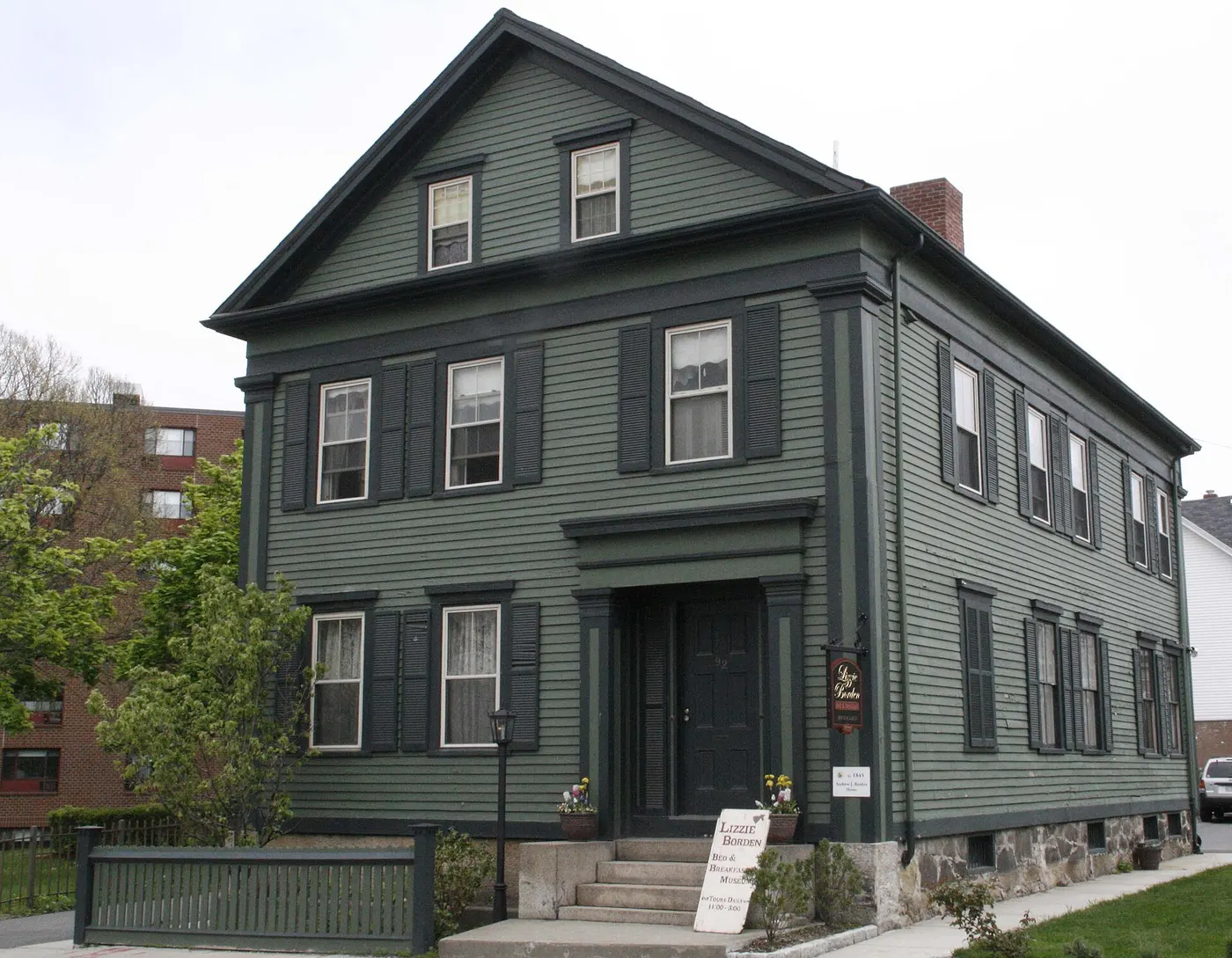
The Lizzie Borden House
The Lizzie Borden House is a mid-19th-century two-story Greek Revival timber residence situated at 230 Second Street (historically 92 Second Street) in the mill city of Fall River, Bristol County, Massachusetts, United States. On the morning of August 4, 1892, the residence was the scene of one of Victorian America's most brutal unsolved homicides: wealthy property owner Andrew Borden and his second wife, Abby Durfee Borden, were hacked to death with an axe or hatchet. The primary suspect was Andrew’s 32-year-old unmarried daughter, Lizzie Borden. Her sensational trial and subsequent acquittal generated enduring historical debate, transforming the property into a functioning museum, a commercial bed-and-breakfast, and an international hub for paranormal tourism.
The legend
Danger Level: Green (A historic 19th-century cold-case crime scene and licensed commercial hospitality establishment posing zero physical danger) Popular culture cemented Lizzie Borden as a psychopathic axe-murderess, driven largely by an anonymous jump-rope nursery rhyme published shortly after her acquittal: "Lizzie Borden took an axe, and gave her mother forty whacks. When she saw what she had done, she gave her father forty-one..." Paranormal lore and sensationalist television features have portrayed the house as one of the most haunted domestic structures in North America. In the second-floor John V. Morse guest room, where Abby Borden's body was discovered between the bed and the dresser, overnight guests report phantom cold spots, indentations appearing across smoothed bedspreads as if weighed down by an unseen figure, and disembodied muffled weeping. In the first-floor parlor, where Andrew Borden was bludgeoned on a horsehair sofa, visitors report shadowy sightings of an elderly man, footsteps pacing over timber floorboards, and sudden chest constriction. On the third floor, which housed Irish housemaid Bridget Sullivan's quarters, folklore alleges disembodied child laughter, self-propelling marbles, and apparitions bearing bladed weapons descending the basement cellar steps.
What actually happened?
Archival trial records, inquest transcripts, and forensic pathology records from 1892–1893 provide an objective account of the crime: Debunking the strike-count myth: Autopsies conducted by medical examiners Dr. William Dolan and Dr. Frank Draper demonstrated that the press radically exaggerated the violence. 64-year-old Abby Borden received 18 to 19 bludgeoning and cutting strikes to the rear of the skull (occurring between 09:00 and 09:30 AM). 69-year-old Andrew Borden, struck while resting on the settee, suffered 10 or 11 strikes focused on the left side of his face (occurring around 11:00 AM). The weapon was determined to be a small hatchet rather than a full-sized lumber axe. Forensic limitations of the era: In 1892, standard criminalistics lacked modern tools. Fingerprint lifting had not yet been adopted by American municipal police forces; blood spatter interpretation was primitive; and the crime scene was left unsecured, permitting dozens of neighbors, physicians, and townspeople to walk through the premises, contaminating vital traces. Lizzie was not subjected to a prompt physical examination for blood traces. Days after the murders, Lizzie burned a blue dress inside the kitchen coal stove, claiming it was stained with brown house paint—an act the prosecution could never forensically link to the killings. A handleless hatchet head caked in ash was recovered from the cellar, but chemical assays of the period could not definitively confirm the presence of human hemoglobin. Victorian gender and class bias: During the June 1893 trial held at the Bristol County Superior Court in New Bedford, defense attorneys capitalized on contemporary social expectations. The all-male jury found it psychologically implausible that a well-bred, churchgoing Sunday school teacher and member of the Woman's Christian Temperance Union could execute such butcherous acts. Because the state’s case was entirely circumstantial and Lizzie’s contradictory inquest statements were excluded due to morphine-induced confusion, the jury returned a verdict of "not guilty" after just 90 minutes of deliberation. Economic motivations: Historians emphasize intense financial friction over Andrew Borden's estate (valued at nearly $300,000, equivalent to roughly $10 million today). Despite his wealth, Andrew enforced an ascetic lifestyle, refusing to install modern indoor plumbing or electricity. Tensions peaked when Andrew deeded residential properties to his second wife, Abby, sparking resentment from Lizzie and Emma, who feared being disinherited. Subterranean acoustics and environmental artifacts: The 1845 wood-frame home rests on dry-laid fieldstone foundations adjacent to urban street traffic. Mechanical ground vibrations generate low-frequency acoustic rattles in vintage mortise locks and floorboards. Thermal cycling, drafts entering historical single-pane window sashings, and psychological priming among overnight visitors seeking macabre sensations account for the alleged supernatural manifestations. Furthermore, child ghost lore on the third floor is entirely baseless, as no children ever lived or died in the Borden household.
History
The residence was constructed in 1845 as a two-family flat. Andrew Borden purchased the parcel in 1872, renovating the floor plan into a single-family house to accommodate himself, his second wife Abby, his daughters Emma and Lizzie, and maid Bridget Sullivan. Following the murders and Lizzie's 1893 acquittal, the sisters inherited their father's substantial fortune, liquidated the Second Street property, and relocated to the affluent Highlands neighborhood of Fall River, purchasing a 13-room Queen Anne mansion on French Street they christened "Maplecroft." Ostracized by local society, Lizzie (who adopted the name Lizbeth Borden) lived out her life in quiet seclusion, dying of pneumonia on June 1, 1927, at age 66. The Second Street property passed through multiple commercial and residential hands—functioning at times as a multi-family rental and a print shop—until 1996, when Martha McGinn and Robert Dielinski restored the rooms to their 1892 configuration and opened the Lizzie Borden Bed & Breakfast Museum. In 2021, the historical real estate was acquired by tour and hospitality operator US Ghost Adventures.
Where is it?
Bristol County, Massachusetts, United States; situated within the urban core of Fall River at 230 Second Street, Fall River, MA 02721 (roughly 80 kilometers south of Boston and 30 kilometers southeast of Providence, Rhode Island).
Can you visit?
Yes, the property is fully accessible, operating continuously as an accredited museum and commercial bed-and-breakfast. Public visitor programs include: Daytime guided tours: Departing daily every half hour (generally 10:00 to 16:00). Period-costumed guides lead groups through the restored interior, exhibiting authentic late-Victorian furnishings matching crime-scene layouts alongside archival documents; Evening ghost tours and overnight paranormal investigations: Late-night ticketed access utilizing electromagnetic field (EMF) meters and audio recording tools; Overnight lodging: Guests can reserve specific historic rooms, including the John V. Morse bedroom (where Abby was killed), Lizzie's private suite, or Andrew Borden's master bedroom. Reservations must be made in advance via the official booking portal. Standard museum rules apply: touching fragile roped-off furnishings is restricted, open flames and smoking are banned, and visitors must observe municipal noise curfews out of respect for neighboring residential blocks.
The White Caver
The underground counterpart of the Black Climber, known to everyone who goes into caves across the former Soviet Union. What makes him white is calcite, settled on his clothes over years below ground. Meeting him traditionally means the party has lost the route. Cavers have a half-joking initiation rite for newcomers in which he is described — a rare case of folklore whose carriers know perfectly well it is folklore, and which is none the weaker for it.
Comments
No comments yet. Be the first.