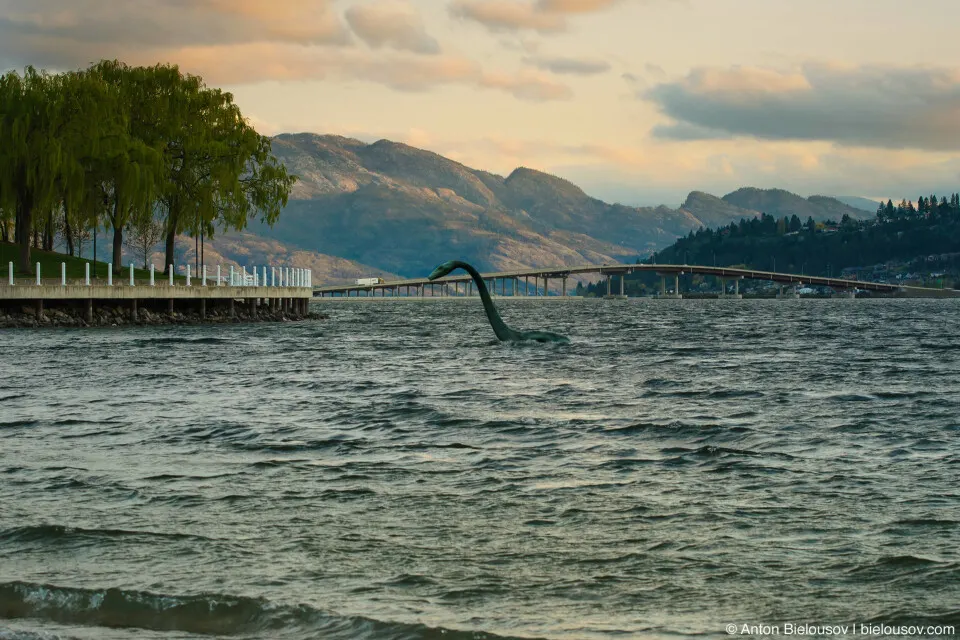
Okanagan Lake and Ogopogo
Okanagan Lake is an elongated, fjord-like glacial lake located within the Okanagan Valley of southern British Columbia, Canada, spanning roughly 135 kilometers north-to-south with depths reaching up to 232 meters. Flanked by semi-arid hills, vineyards, and the municipalities of Kelowna, Vernon, and Penticton, the basin has achieved international recognition as the epicenter of North American cryptozoology: the alleged domain of "Ogopogo," Canada's definitive lake monster archetype.
The legend
Danger Level: Green (A scenic, safe recreational tourism corridor accompanied by indigenous oral folklore posing zero physical threat) The mythology originated in the sacred oral tradition of the indigenous Syilx (Okanagan) First Nation, who revered an aquatic spirit known as N’ha-a-itk (or Naitaka, meaning "sacred entity of the water"). According to Syilx lore, the spirit inhabited submerged caverns near Squally Point across from Rattlesnake Island; paddlers offered tobacco or small live game before traversing the deep waters to appease the lake's volatile moods and survive treacherous seasonal squalls. European settlers commodified this metaphysical tradition into a literal flesh-and-blood cryptid: an ancient serpentine predator or surviving marine reptile. From the late 19th century onward, eyewitness accounts reported a multi-humped serpent measuring 10 to 15 meters long, exhibiting dark greenish-brown skin, a paddle-like tail, and the facial structure of a horse or goat. In the 1920s, the creature was rebranded with the music-hall moniker "Ogopogo," prompting cryptozoological hunts, commercial reward bounties, and grainy amateur recordings (the 1968 Art Folden film, the 1989 Ken Chaplin video) purported to show glistening organic ridges breaking the water.
What actually happened?
Systematic limnological surveys, environmental optics, and ethnographical research have stripped the phenomenon of its supernatural veneer: Appropriation of Syilx cosmology: Elders of the Syilx Okanagan Nation have documented that N’ha-a-itk was never a physical reptilian beast. It represented an animistic water entity symbolizing the unpredictable forces of the lake itself—cold upwellings, thermal hazards, and steep waves capable of capsizing light bark canoes. European colonizers appropriated and secularized this spiritual stewardship into a tourist-friendly cryptid monster. Internal thermal seiches: Okanagan Lake is a deep, narrow tectonic trough characterized by pronounced seasonal thermal stratification. Frontal wind shifts and barometric variations generate massive subsurface internal seiches along the thermocline. When these oscillations interact with surface layers, they form undulating solitary wave trains. Viewed from shore elevations at shallow angles, these rolling wave crests create a convincing optical illusion of a multi-segmented serpentine creature swimming against the current. Boat wake interference and solitons: High concentrations of pleasure craft and ski boats during summer create colliding wake trains. Displaced hull wakes travel vast distances across calm water, reflecting off sheer rock palisades to form solitary constructive interference humps long after the motorized vessel has departed the horizon. Fauna and drifting timber: The valley's industrial history of log booming left substantial submerged debris. Waterlogged pine "deadheads" floating at acute angles bob rhythmically, resembling raised periscopic heads. Furthermore, traveling family groups of North American river otters (Lontra canadensis) porpoising in a tight single file replicate an undulating, segmented aquatic serpent to distant binoculars.
History
The earliest documented settler account dates to 1872, when pioneer settler Susan Allison recorded observing anomalous ripples and an unidentified dark form off Sunnyside. In 1924, a popular British music-hall song titled "The Ogo-Pogo: The Funny Foxtrot" (penned by Cumberland Clark and Mark Strong) circulated across the province, prompting local journalists to rebrand the legendary entity as "Ogopogo." By the 1980s, the Kelowna Chamber of Commerce announced a $1 million cash bounty for certified, non-lethal evidence of the creature. In 1989, provincial heritage legislation granted the hypothetical creature official protected status under the BC Wildlife Act to preempt trophy hunters. Over subsequent decades, the monster transitioned into a celebrated regional icon, highlighted by public sculptures along the Kelowna boardwalk, municipal heraldry, and regional sports franchises.
Where is it?
Central Okanagan Regional District, British Columbia, Canada; situated in the southern interior plateau between the Columbia and Cascade mountain systems, approximately 380 kilometers east of Vancouver. Key historical folkloric nodes include Squally Point and the uninhabited Rattlesnake Island, situated adjacent to Okanagan Mountain Provincial Park.
Can you visit?
Yes, Okanagan Lake, the civic harbor of Kelowna, and adjacent provincial parks are fully open to the public year-round. BC Highway 97 provides complete vehicle access along the shoreline. The lake features extensive recreational amenities, including marina charters, kayak rentals, public beaches, and paddlewheeler tours. Rattlesnake Island and Squally Point can be accessed by private watercraft; landing on the island is permitted, though visitors must exercise caution along scree slopes and remain vigilant for indigenous Western rattlesnakes (Crotalus oreganus). Primary navigational hazards involve sudden katabatic squalls capable of generating dangerous chop and hypothermia risks associated with cold deep waters.
Seljordsvatnet and Selma
A lake in Norway's Telemark county where a serpent called Selma has been described since 1750. In the 1880s a woman named Gunhild Bjøge is said to have killed a young one on the shore with an axe. The serpent appears on the coat of arms of Seljord municipality — that is, in official heraldry. A sonar expedition in 2000 recorded moving objects on the bottom that it could not identify.
Comments
No comments yet. Be the first.