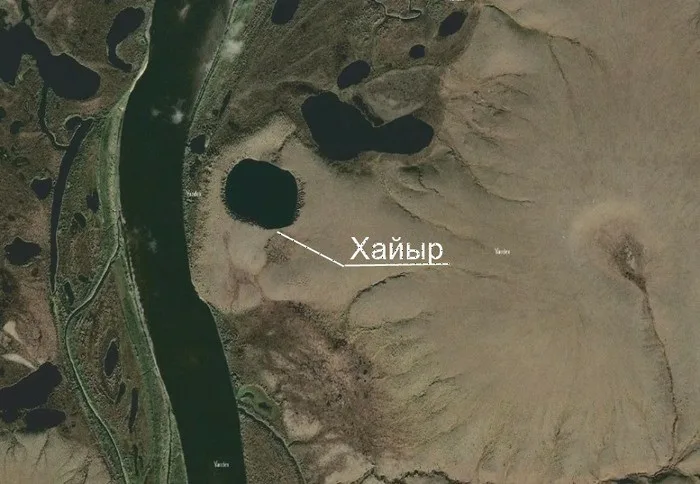
Lake Khaiyr
Lake Khayyr is a small, landlocked thermokarst lake situated within the subarctic tundra of the Ust-Yansky District in the Sakha Republic (Yakutia), Russia, located in the lower basin of the Omoloy River north of the Arctic Circle. In 1964–1965, this remote northern water body gained nationwide prominence when Soviet periodicals reported sightings of the "Khayyr Monster" ("Khayyr Beast")—an alleged relict aquatic reptile sporting an elongated neck and dorsal crest, transforming the lake into the Soviet Union's counterpart to the Loch Ness myth.
The legend
Danger Level: Yellow (Extreme subarctic tundra wilderness, permafrost wetlands, swarms of mosquitoes, and total geographic isolation mythologized into a prehistoric lake monster encounter) According to regional folklore, indigenous Yakuts and Evens historically avoided the water body, declaring it cursed and inhabited by an aggressive aquatic spirit or a horned water bull (muus oghuha) capable of ramming birchbark canoes and dragging reindeer into the depths. In November 1964, the myth exploded into mainstream media. Nikolai Gladkikh, a field worker attached to a Moscow State University biological research detachment, claimed he encountered a creature hauling itself onto the lakeshore while he was fetching camp water. He described a long-necked animal with an ophidian head, a bulky blue-black torso, a vertical dorsal crest, and a sweeping tail that plunged back into the depths upon detecting him. The expedition's deputy leader, G. N. Rukosuev, subsequently corroborated the narrative in nationwide print, claiming multiple team members observed a large silhouette breaching the lake surface and thrashing its appendages. Soviet speculative publications and fringe cryptozoologists labeled Lake Khayyr an isolated sanctuary for surviving prehistoric plesiosaurs.
What actually happened?
Rigorous follow-up inquiries conducted by the USSR Academy of Sciences, alongside surveys by hydrologists and permafrost researchers, dismantled the myth: Trophic capacity and limnology: Lake Khayyr covers an area of less than 0.5 square kilometers with typical depths of just 2 to 4 meters (punctuated by occasional sinkholes down to 7–8 meters). As a young, nutrient-poor tundra basin, its biomass comprises sparse benthic flora, minnows, and isolated northern pike. The ecosystem lacks the caloric reserves necessary to support a breeding colony of massive apex predators. Arctic winter anoxia: Winter across the lower Omoloy lasts over eight months, with ambient temperatures plummeting to -50 °C to -60 °C. Solid ice forms sheets 1.5 to 2 meters thick, occasionally freezing shallow margins to the lakebed. Stagnant under-ice environments suffer from winterkill (total depletion of dissolved oxygen caused by decomposing organic sediment). Any large air-breathing reptile or deep-water organism would suffocate under such conditions. Retraction and witness fabrication: Investigations published in periodicals like Vokrug Sveta in 1965 revealed that the initial report was an intentional embellishment by Gladkikh, who lacked scientific training. Under scrutiny, his testimonies contradicted basic anatomical geometry. Field leader Rukosuev subsequently conceded that cognitive priming influenced his team, who mistook wind-induced chop and diving waterfowl for a surfacing organism. Hydrogeological illusions and regional fauna: Sub-lacustrine permafrost thaw periodically releases trapped methane pockets. Subsurface gas eruptions displace water, elevate rafts of dark fibrous peat, and generate concentric surface swells, which mirror a surfacing animal when viewed through arctic mist. Furthermore, swimming Eurasian tundra reindeer with antlers held low, or diving red-throated loons (Gavia stellata) extending their slender necks, are routinely mistaken by distance observers for a miniature plesiosaur.
History
The lake lies adjacent to ancestral Yakut and Even hunting territories where Soviet authorities organized the collective pastoral village of Khayyr (the seat of the Omoloy National Rural Settlement) during the 1930s. The international episode began on November 21, 1964, when Komsomolskaya Pravda ran an article titled "Some Sort of Animal...". The report sparked widespread curiosity across scientific bodies and outdoor societies. In summer 1965, the Moscow Society of Naturalists (MOIP) mobilized an expedition featuring sport divers and geologists. Divers executed systematic bottom grids, collected water chemistry profiles, and mapped the bathymetry, confirming the lake was devoid of megafauna, sub-surface conduits, or cryptozoological traces. By the late 1960s, academic institutions classified the sighting as a journalistic hoax, though the site remains a staple in post-Soviet cryptozoological literature alongside Lake Labynkyr and Lake Vorota.
Where is it?
Ust-Yansky District, Sakha Republic (Yakutia), Russia; located in the tundra lowlands of the Omoloy River basin, roughly 12 to 15 kilometers northeast of the rural locality of Khayyr, approximately 600 kilometers north-northeast of Yakutsk and 120 kilometers west of the municipal district center of Deputatsky.
Can you visit?
Accessing Lake Khayyr is logistically grueling due to subarctic climatic conditions and a complete absence of all-weather roads. Transport and seasonality: Summer access to the village of Khayyr requires chartered regional aircraft (Mil Mi-8 helicopters or Antonov utility planes out of Batagay or Deputatsky, subject to weather clearance) or long-distance riverboats along the Omoloy River; the remaining overland approach mandates tracked all-terrain vehicles, specialized balloon-tire haulers (Trekol), or demanding treks through boggy muskeg. In winter, transit relies on seasonal ice roads (zimniks) utilizing heavy 4x4/6x6 transport and snowmobiles. Wilderness risks: The area lacks cellular coverage, and emergency medical services are located hundreds of kilometers away. Summer hazards include thick insect swarms requiring protective bug nets, hypothermia caused by polar squalls, and brown bear encounters. Expeditions demand satellite communications, redundant rations, multi-fuel stoves, and local indigenous trail guides.
Bukit Timah and the Monkey Man
Singapore's highest point and a remnant of primary rainforest in the middle of the city. A creature has been described here since 1805, known as the Bukit Timah Monkey Man: grey-furred, about five feet tall, moving on two legs. Reports came in waves — notably during the Japanese occupation, when people were hiding in the forest, and again in 2007, which caused a stir in the Singapore press.

Comments
No comments yet. Be the first.