
Coyote Canyon and the Coyote Springs tract
Coyote Canyon and the Coyote Springs tract form a rugged canyon featuring natural mineral springs nestled at the foot of the Manzanita Mountains southeast of Albuquerque, New Mexico, USA. In the late 19th century, it was a quiet destination for wilderness camping and convalescence; in modern history, it became one of America’s most secretive and anomalous military corridors, absorbed into the restricted perimeter of Kirtland Air Force Base and Sandia National Laboratories—nearly a century before the Paul Bennewitz affair made it globally famous.
The legend
Danger Level: Yellow (Anomalies are observed, but no one is harmed) On the evening of September 2, 1891, Civil War veteran Captain Alonzo M. Swan and equestrian L. D. Dodson, camped near Coyote Springs, reported watching a silent navigable craft maneuver across the night sky. They described an orderly, geometric constellation of brilliant lights—two distinct lines of glowing orbs flanking a luminous central core—gliding smoothly against the wind and contouring the mountain ridges. Two nights later, on September 4, Captain Swan reported seeing the identical illuminated craft hovering above the canyon. The encounter is considered an exceedingly rare precursor, predating the nationwide Great Airship Flap of 1896–1897 by five full years.
What actually happened?
Astronomers and skeptics generally attribute the 1891 sighting to a rare bolide fragmentation event: a slow-moving meteor breaking apart in the upper atmosphere, where multiple glowing debris trails travel in rigid formation, mimicking the cabin lights of a colossal solid fuselage. An alternative geological hypothesis points to piezoelectric tectonic lights and atmospheric plasma discharges along the active Manzanita fault line. However, unlike typical sensationalized tall tales of the 19th-century frontier press, Captain Swan was a respected surveyor and combat veteran whose geometric diagram of the light pattern remains one of the most credible pre-aviation anomalous aerial records in history.
History
Captain Swan’s detailed written account, complete with light pattern diagrams, was first published in the Albuquerque Weekly Citizen on September 12, 1891. The case remained an obscure historical footnote until researchers Chris Aubeck and Martin Shough thoroughly analyzed and contextualized the sighting in their study Return to Magonia (2015). The location holds profound historical irony: decades later in the late 1970s and 1980s, the very same sector of Coyote Canyon and the adjacent Manzano base became the focal point of the Paul Bennewitz surveillance saga and AFOSI officer Richard Doty's infamous counterintelligence operation.
Where is it?
Coyote Springs / Coyote Canyon, Bernalillo County, New Mexico, USA, situated at the eastern base of the Manzanita Mountains (roughly 10–11 miles / 16 km southeast of downtown Albuquerque).
Can you visit?
No. The actual Coyote Springs site and the canyon floor are strictly closed to the general public, as they lie entirely within the secure military perimeter of Kirtland Air Force Base, Sandia National Laboratories test grounds, and the Manzano weapons storage complex. However, the mouth of the canyon and the mountain ridgeline can be viewed from public access areas along NM-333 (Historic Route 66), the Tijeras Pueblo archaeological site, and the foothills near Carnuel north of the military boundary.
Found by
Gulf Breeze and Ed Walters's Photographs
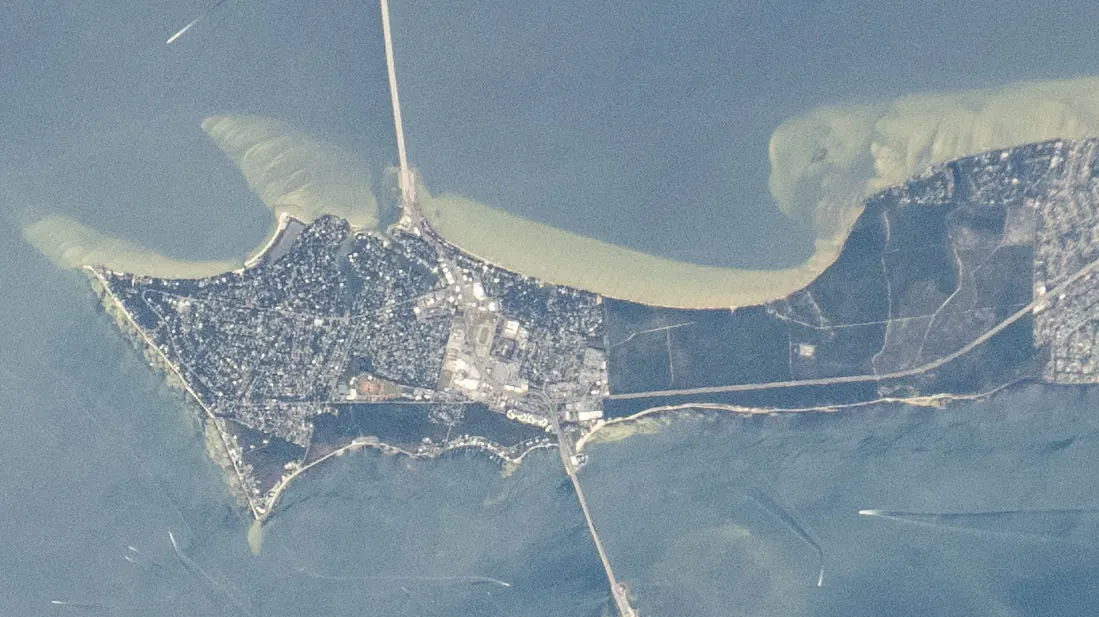
From November 1987 a contractor named Ed Walters brought a series of photographs of a glowing object with a row of ports along its underside to the local paper in this Florida town — anonymously at first, then under his own name. Within two years there were some forty pictures, and Gulf Breeze had become a place of pilgrimage. In 1990 the new occupants of the Walters house found a model made of foam and film in the attic, matching the object in the photographs. Walters said it had been planted. Meanwhile other residents, police officers among them, were reporting lights over the sound in those same years, and some of those reports have nothing to do with Walters. The case remains a classic of how one disputed witness drowns out everything else.
Comments
No comments yet. Be the first.