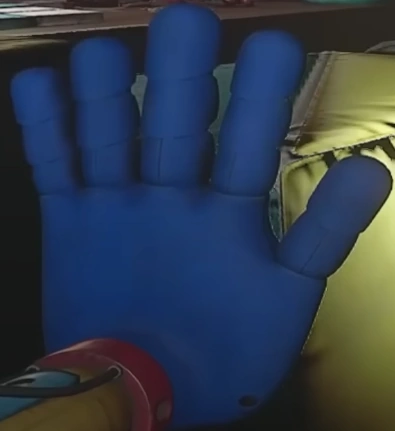
The Blue Hand
The Artek International Children's Center (formerly the All-Union Pioneer Camp Artek) on the southern coast of Crimea near Gurzuf. Covering over 200 hectares beneath the slopes of Bear Mountain (Ayu-Dag), the world's largest youth camp complex functioned as the primary creative incubator for Soviet children's oral folklore. Here, around evening campfires and along the Black Sea shore, the quintessential Soviet camp creepypasta—the tale of the "Blue Hand"—was honed and passed down across generations.
The legend
Danger Level: Green (Children's camp folklore posing zero physical threat) The classic oral horror story traditionally whispered after lights-out in dormitories or shared around seaside campfires: "In a black, black town, on a black, black street, stood a black, black camp..." In the standard narrative, a crackling radio, vinyl record, or disembodied voice inside the walls counted down an impending supernatural breach: "Girl, girl, the Blue Hand has found your camp... the Blue Hand is in your hallway... the Blue Hand is entering your room..." At the climax, a severed, glowing corpse-blue hand slipped silently across the windowsill or crawled out from beneath the bedframe to strangle the sleeper, with counselors discovering only blue bruising on the victim's neck at roll call. Within Artek, the story adopted regional motifs: the ghost of a drowned girl from the "Morskoy" shoreline camp, a fallen climber whose severed hand roamed the cliffs of Ayu-Dag, or a cursed plaster pioneer statue in the park coming alive after midnight.
What actually happened?
The "Blue Hand" is a textbook artifact of Soviet juvenile folklore that coalesced in the late 1960s and 1970s. The phenomenon has been extensively analyzed by Russian philologists and ethnographers (notably A. F. Belousov, S. M. Loiter, and developmental psychologist M. V. Osorina). Scientifically, camp scary stories performed a vital social-developmental function: arriving at sleepaway camps between ages 9 and 12, children encountered prolonged parental separation, unfamiliar peer hierarchies, darkness, and an emerging consciousness of mortality for the first time. The ritualized delivery of formulaic horror allowed youth to collectively regulate ambient fear, inducing controlled physiological terror in a secure setting before discharging tension via the narrator’s final jump scare and shared cathartic laughter. Artek—processing hundreds of thousands of high-achieving youth annually from across the Soviet Union—served as the supreme national distribution hub, absorbing regional variants, refining them through counselor traditions, and dispersing the standardized canon back to every corner of the country.
History
Artek was founded on June 16, 1925, initially operating as an open-air canvas tent sanatorium for children recovering from tuberculosis under the auspices of the Russian Red Cross Society (the inaugural session welcomed just 80 pioneers). During the 1930s, the facility absorbed nationalized pre-revolutionary estates and villas (such as the historic Suuk-Su resort), emerging as the showcase youth institution of the USSR. In the 1960s, a modernist overhaul designed by architect Anatoly Polyansky added glass-and-steel coastal pavilions. The structured tradition of evening campfires, counselor-led storytelling, and the end-of-term "Royal Night" (in which campers secretly smeared roommates with white toothpaste) peaked in the 1970s and 1980s, cementing tales of the "Black Sheet" and the "Blue Hand" into the shared cultural memory of generations.
Where is it?
41 Leningradskaya Street, Gurzuf, Yalta Municipality, Southern Coast of Crimea; encompassing the Artek coastal strip stretching from Genoese Rock to the base of Cape Ayu-Dag.
Can you visit?
The Artek International Children's Center is a closed, secure institutional youth campus with strictly regulated access. Casual pedestrian entry to the residential campuses is prohibited, secured by private guard details and perimeter checkpoints. Camp grounds are reserved for children aged 8 to 17 admitted via merit-based application vouchers or purchased youth packages. Adult tourists can access select heritage sites—such as the Suuk-Su Palace museum and the Yuri Gagarin Cosmonautics Museum—strictly via advance-registered guided institutional tours. Independent hikers can view the grounds from above by taking the public eco-trail ascending Mount Ayu-Dag, which bypasses the secured coastal perimeter.
The Coffin on Wheels
The best-known Soviet children's horror story, told in pioneer camps after lights-out. A voice on the radio announces that the coffin on wheels has set off and is coming down the street, then into the yard, then up the stairs; the floors are counted aloud, and on the last line the teller grabs whoever is next to them. The device is purely theatrical — the whole structure exists for one second at the end, and the fear is generated not by the plot but by the countdown. The pin is at Artek as the country's most famous camp, but it was told everywhere.
Comments
No comments yet. Be the first.