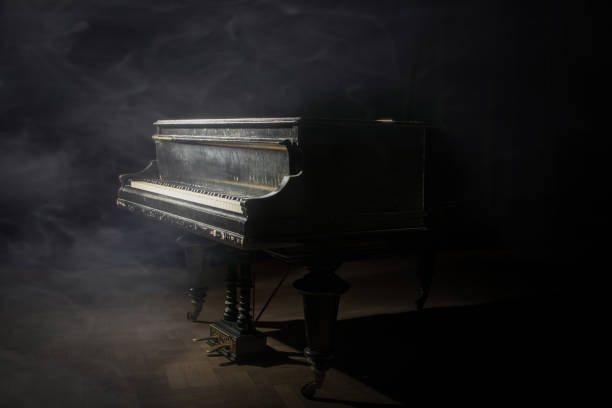
The Black Grand Piano
Children's music schools, assembly halls of Soviet pioneer camps, and youth pioneer palaces (anchored symbolically by the Moscow Pioneer Palace on Sparrow Hills). Within Soviet juvenile subculture of the 1970s and 1980s, the classical instrument of bourgeois prestige and musical education transformed into the central artifact of an iconic urban horror legend: the "Black Grand Piano" (or "Black Upright"), which secretly drained the blood of young musicians.
The legend
Danger Level: Green (Children's camp and urban folklore posing zero physical threat) The classic oral horror story exchanged after lights-out in Soviet dormitories: a respectable family purchases a secondhand, high-gloss black grand piano (or upright) for a suspiciously low price. The mysterious seller issues a strict warning: "Never press the lowest black key" (or "never play at midnight"). The daughter begins practicing scales, accidentally violates the taboo, and the instrument takes on a life of its own: keys depress autonomously, playing Chopin's Funeral March. Night after night, family members fall ill with sudden anemia or vanish entirely. When detectives finally take an axe to the instrument's wooden soundboard, they uncover a mechanical skeleton, a reanimated vampire limb, a brood of serpents, or a covert hydraulic pump integrated into the brass pedals that secretly drained the young pianist's blood into a concealed zinc reservoir.
What actually happened?
The "Black Grand Piano" is a textbook case of juvenile projective coping mechanisms and urban folklore, thoroughly cataloged by Russian ethnographers and psychologists. The narrative emerged from three intersecting cultural, psychological, and acoustic factors of the mid-to-late Soviet era: The trauma of enforced musical discipline: between the 1960s and 1980s, an upright piano was the supreme domestic status symbol of cultured Soviet households. Millions of children were subjected to hours of rigorous, non-negotiable finger drills and solfège against their will. Children unconsciously externalized the hated instrument into a domestic monster draining their vitality and stealing their childhood. Acoustic physics of tensioned cast iron: standard Soviet upright pianos ("Red October," "Lirika") house a heavy cast-iron plate holding up to 20 tons of string tension. Ambient nocturnal humidity drops and radiator heating caused wooden soundboards to contract, producing spontaneous, metallic twangs and deep resonance in the dark, convincing imaginative children that the piano was playing on its own. Spatial claustrophobia: inside compact, low-ceilinged Khrushchev-era apartments, a massive, black-lacquered wooden monolith occupied a dominant fraction of the living space, visually evoking an imposing funerary casket.
History
Following post-WWII reconstruction, Soviet manufacturing scaled up domestic piano production, establishing a vast network of municipal music schools across all republics. Formal classical education became a universal cultural expectation. By the early 1970s, the story of the lethal piano had solidified into a campfire staple, migrating across all summer pioneer facilities during afternoon quiet hours. In 1990, prominent children's authors Eduard Uspensky and Andrey Usachyov documented this oral folklore in their celebrated book "The Red Hand, the Black Sheet, and the Green Fingers," officially canonizing the musical vampire into modern Russian literature.
Where is it?
17 Kosygina Street, Sparrow Hills, Moscow, Russia (The Moscow Pioneer Palace, the flagship architectural monument of Soviet youth education), alongside the historic "Red October" Piano Factory in St. Petersburg, where the bulk of the nation's acoustic pianos were engineered.
Can you visit?
Yes, the Moscow Pioneer Palace on Sparrow Hills is a public educational landmark that completed a comprehensive restoration in 2023. The surrounding landscaped park, modernist winter garden, monumental Soviet mosaic murals, and auditorium stages housing grand pianos are open during public events, cultural tours, and creative youth classes.
Cartoon Cat
Henderson drew it in August 2018, days after Siren Head. The creature is done in the visual language of 1930s American animation — rubber-hose limbs, saucer eyes, a permanent grin — but stands two storeys tall and has teeth a cartoon cat should not have. The trick is a single one and it works every time: take an idiom an entire generation associates with safety and childhood, and scale it up until it stops being funny.
Comments
No comments yet. Be the first.