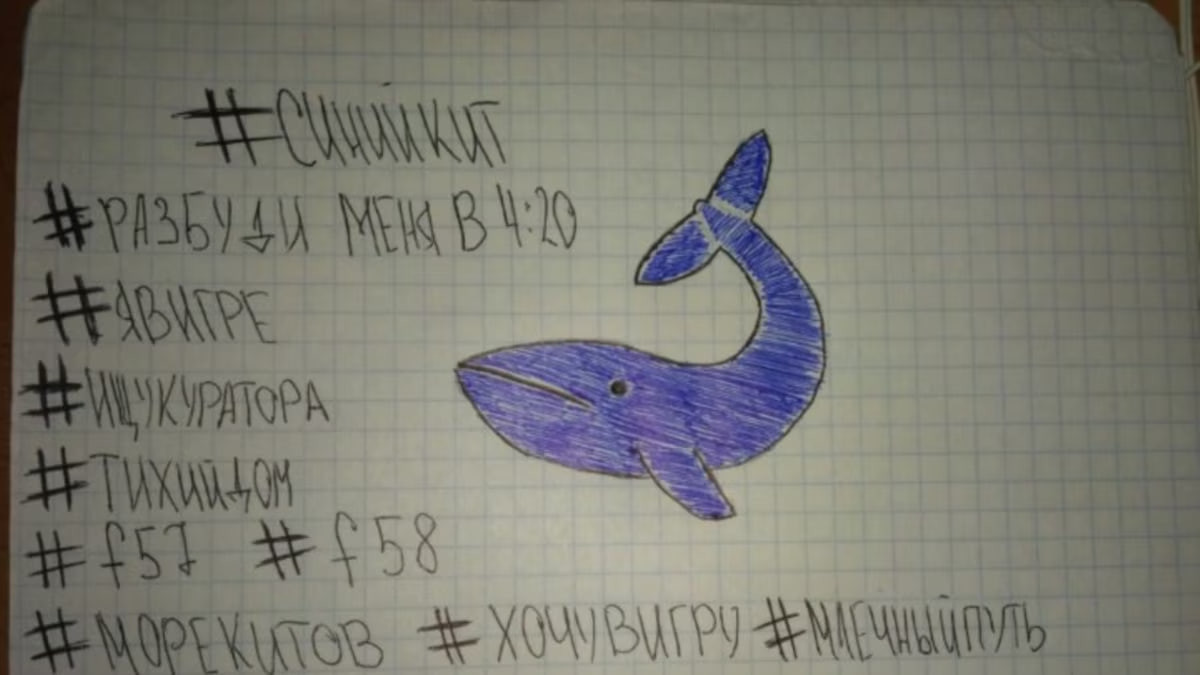
The "Blue Whale"
The "Blue Whale" phenomenon (also known as "Death Groups," "f57," "Quiet House," or "Wake Me Up at 4:20") is a viral digital urban legend, an international moral panic, and a destructive social-media alternate reality game (ARG) that originated within the Russian-speaking web (principally the VKontakte platform) in late 2015. Between 2016 and 2017, the narrative of a clandestine syndicate of online "curators" systematically coercing hundreds of teenagers into self-harm across a 50-day sequence triggered massive public panic, prompted reforms in Russian criminal law, and gained global infamy as a supposed worldwide cyber threat.
The legend
Danger Level: Orange (Severe digital manipulation, cyberbullying, and societal hysteria posing acute psychological hazards to vulnerable youth) According to the urban legend popularized by sensationalist media and peer rumor networks, a coordinated syndicate of adult manipulators operated online. An adolescent posting specific hashtags (#bluewhale, #iamingame, #quiet_house, #f57, #wakemeupat420) was contacted privately by an anonymous "curator." The handler exerted absolute psychological dominance over 50 days. The victim received daily escalating directives: waking at 4:20 AM, consuming grim audiovisual media, carving whale silhouettes into their forearms, balancing on rooftop ledges, and severing ties with family. On the 50th day, the curator issued a final command to commit suicide. Defiance was met with extortion: operators deployed basic IP-logger links, identified the user's geographic city, and threatened to murder the participant's parents if they backed out. Sensationalist news outlets claimed this central network was directly responsible for at least 130 adolescent suicides across Russia.
What actually happened?
Academic research by digital anthropologists at RANEPA (Dr. Alexandra Arkhipova's working group), detailed investigative journalism, and law enforcement findings systematically dismantled the conspiracy: Statistical distortion: The nationwide panic was ignited by Galina Mursalieva's May 2016 article "Death Groups" in Novaya Gazeta. The assertion that "130 adolescent suicides" were caused by online curators was a severe methodological flaw: the author aggregated general adolescent suicide statistics across Russia over a multi-month window and arbitrarily linked them to social media groups without empirical forensic causation. Commercial and trolling motives (f57): The communities were not operated by sophisticated cults, but by juvenile trolls—most notably 21-year-old Philipp Budeikin ("Philipp Lis"). Their objectives were shock-value trolling, capturing massive follower counts to later monetize groups as commercial advertising vectors, and fulfilling narcissistic power dynamics. The whale symbolism was derived from mainstream Russian youth culture: Stace Kramer's popular novel 50 Days Before My Suicide and alternative rock lyrics, rather than an esoteric death cult. Folklore ostension: No unified, hierarchical suicide syndicate ever existed. However, hyper-sensationalist press coverage triggered the sociological phenomenon of ostension—the enactment of an urban legend in real life. Millions of teens posted the tags out of peer curiosity or to mock the game. Concurrently, thousands of bored youths created alt accounts acting as amateur "curators," sending scripted copypastas to frighten peers. The "IP Geolocation" bluff: Threats against participants' families were hollow intimidation tactics. Trolls baited targets with basic IP-logging redirect links that merely resolved an ISP hub and metropolitan region, accompanied by dramatic threats: "We have your home coordinates; jump or your family dies." No physical harm was ever executed by handlers. Clinical reality: In the isolated cases where self-harming adolescents frequented these boards, participation was a symptom of pre-existing chronic clinical depression, severe social isolation, domestic trauma, or peer bullying, rather than an externally imposed, hypnotic game mechanic.
History
The genesis traces to November 23, 2015, in Ussuriysk, when 16-year-old student Renata Kambolina (online pseudonym Rina Palenkova) died by suicide on a railway spur after posting a photo captioned "Nya. Bye." Her image became a viral shock-meme across Russian message boards. The founder of the VK community "f57," Philipp Budeikin, capitalized on the tragedy, claiming Rina was the vanguard of a secret sect. By December 2015, early iterations of the online game circulated, though platform moderators suspended the initial network by spring 2016. On May 16, 2016, the Novaya Gazeta feature unleashed an institutional panic across parent groups, school boards, and state agencies. On November 15, 2016, Russian Investigative Committee agents arrested Budeikin in Solnechnogorsk. In July 2017, the Tobolsk District Court sentenced him to three years and four months in a minimum-security penal colony for attempting to incite two teenagers to self-harm (both survived). In June 2017, the Russian Parliament enacted severe amendments to the Criminal Code (Articles 110.1 and 110.2), establishing up to 15 years' imprisonment for organizing online pro-suicide activities. By 2017–2018, the panic crossed international borders into Latin America (Brazil, Colombia), India, Europe, and the United States. Foreign school districts and law enforcement agencies issued unverified public advisories that inadvertently reinforced the urban legend abroad.
Where is it?
Russia (and its subsequent international digital diffusion); centered within the infrastructure of the VKontakte social media platform (Saint Petersburg; headquarters at the Singer House, 28 Nevsky Prospekt). Tangible physical nodes include Ussuriysk, Primorsky Krai (the death site of Rina Palenkova), Solnechnogorsk, Moscow Oblast (the residence and arrest site of administrator Philipp Budeikin), and Tobolsk, Tyumen Oblast (the venue of the trial).
Can you visit?
Joining the "game" is impossible because a structured organization never existed. All digital spaces, discussion threads, and hashtags referencing "Blue Whale," "f57," or "Quiet House" are permanently banned across platforms and cataloged by state internet regulators. Global platforms (VK, Instagram, TikTok, YouTube) deploy automated suppression filters: entering any related keywords instantly restricts results and surfaces localized crisis intervention hotlines and psychological counseling resources. Creating copycat groups or distributing extortion messages is prosecuted under international anti-cyberbullying and endangerment statutes.
Found by
Smile Dog
One of the first internet horror stories built around a file rather than a text. It appeared around 2008: a journalist visits a woman to ask about a picture called smile.jpg that drives mad everyone who sees it; the woman refuses to talk and eventually sends the file. The trick is that the file does not exist — every "original" circulating online appeared after the story did. The reader has to imagine the image, and imagination does the job better than any drawing.
Comments
No comments yet. Be the first.