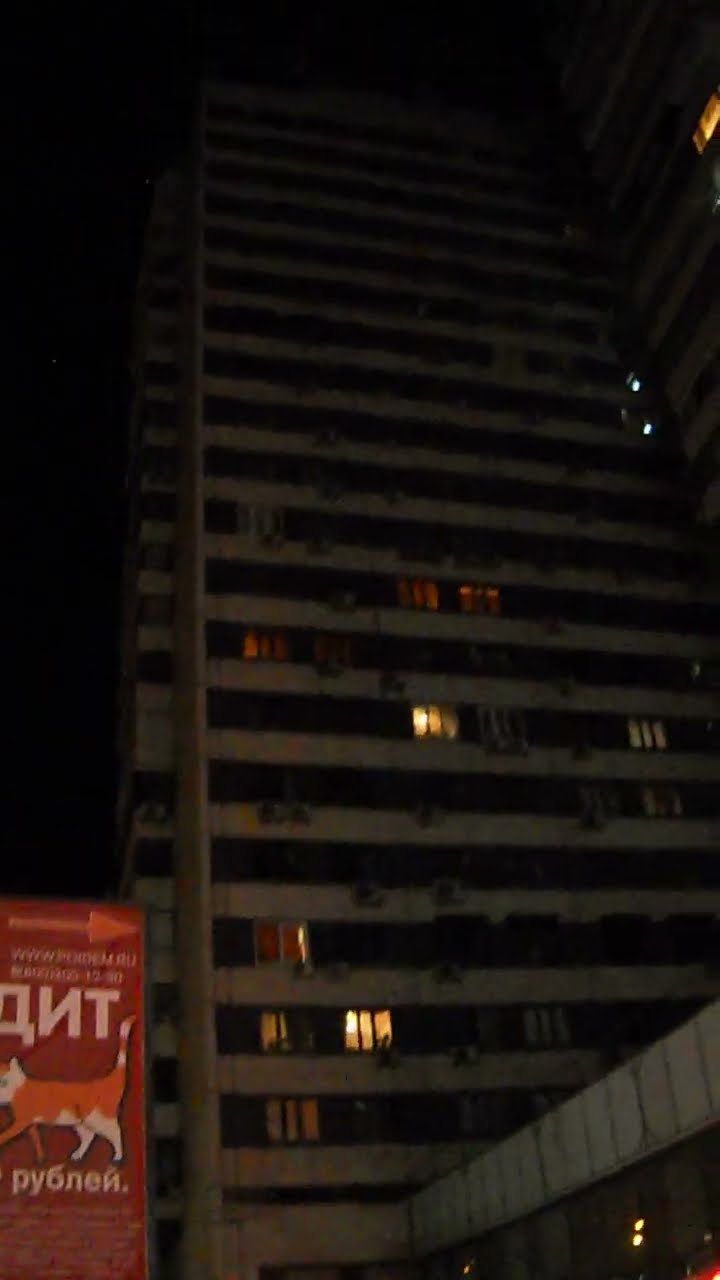
The Blinking Windows
A residential high-rise building located at 7 Krasnoznamenskaya Street in the Central District of Volgograd, Russia. Originally converted from an unfinished Soviet hotel complex near the Piramida shopping center, the tower became the epicenter of one of the Russian internet's most viral urban legends of the 2010s: the mystery of the 11th-floor windows that rhythmically flashed into the night for years on end.
The legend
Danger Level: Green (A real residential building with internet lore posing no danger to visitors) According to digital creepypasta that originated on the 2ch imageboard in 2011, precisely at 10:00 PM every night, the windows of an 11th-floor apartment began strobing in a continuous, hypnotic rhythm. Dozens of amateur videos documenting the flashes circulated online. Conspiracy theorists speculated that the rhythmic light was transmitting optical Morse code, that the apartment housed an active intelligence safehouse or clandestine server bank, or that psychological frequency experiments were being conducted on the city. The myth was magnified by online lore claiming that civilian investigators who tried to track down the apartment door and question the owners mysteriously disappeared without a trace.
What actually happened?
The mystery was thoroughly debunked as a mundane domestic electrical malfunction magnified by collective internet paranoia. The 11th-floor residence was a standard, two-story private apartment occupied by a regular local family. Subsequent journalistic investigations and resident statements confirmed that the strobing was caused by a faulty power supply unit and voltage cycling across decorative lighting fixtures (failing ballasts or relays cycling on and off continuously). The supposed disappearances of forum researchers were simply anonymous users abandoning throwaway internet accounts once interest waned (with the original author merely moving to St. Petersburg). The faulty fixtures were subsequently replaced, putting a permanent end to the light anomaly.
History
The phenomenon began in the spring of 2011 when a user nicknamed MedicParanoic uploaded the first nighttime footage of the strobing windows, triggering a multi-year crowd-sourced internet investigation. Several amateur sleuths infiltrated the building, discovering an access-controlled corridor and a resident who refused to answer suspicious questions, which only fueled speculation. In 2015, audio recordings surfaced of the female occupant explaining that the flashing was a simple electrical short circuit and that uninvited internet onlookers were harassing the household. In August 2024, regional news outlet V1.RU conducted an in-depth retrospective, interviewing current tenants and building staff, putting an end to the prominent urban mystery of 2010s Volgograd.
Where is it?
7 Krasnoznamenskaya Street, Central District, Volgograd, Russia; a residential tower located opposite the Piramida shopping center and Pionérskaya Metrotram station.
Can you visit?
Viewing the building and the former flashing windows from Krasnoznamenskaya Street, the surrounding park, or the public plaza of the Piramida mall is completely free and unrestricted at any time. Entry into the building itself is restricted: the residential entrance is monitored by a concierge desk, intercoms, and magnetic access controls. As the apartments are private residences, unauthorized entry into the stairwells is prohibited.
The Red Stain
One of the most widespread Soviet scary stories. A family moves into a new flat and finds a red stain on the ceiling or the wallpaper that will not wash off and will not paint over: every morning it comes through again, a little larger. At night people vanish from the room, one at a time, and after each one the stain is brighter. The moral, in the children's telling, is always the same and always said out loud: they should have called the police at once.
Comments
No comments yet. Be the first.