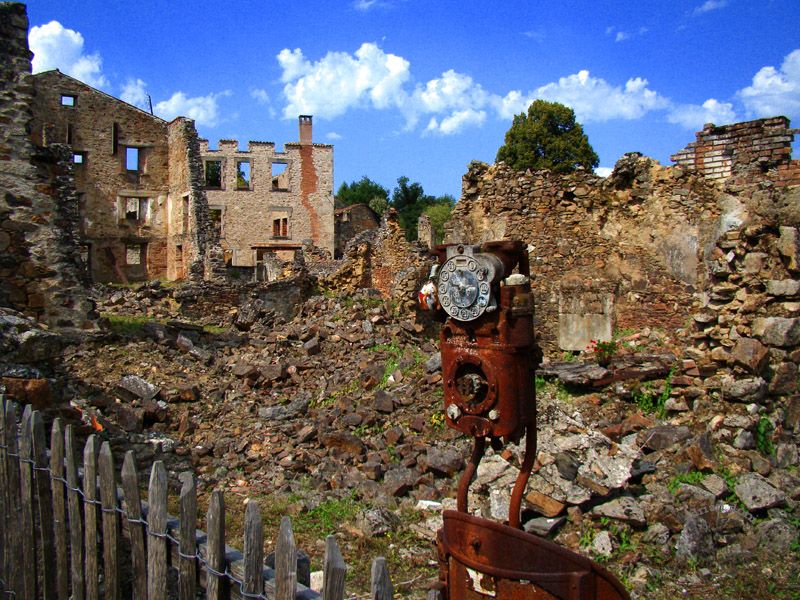
Oradour-sur-Glane
Oradour-sur-Glane is a preserved ghost village and national memorial located in the Haute-Vienne department of Nouvelle-Aquitaine, France, situated along the Glane River roughly 22 kilometers northwest of Limoges. On June 10, 1944, the tranquil rural community was systematically liquidated by the 2nd SS Panzer Division Das Reich, who massacred 643 civilians (including 247 women and 205 children) before putting every structure to the torch. Following the liberation, French Provisional Government President Charles de Gaulle decreed that the skeletal ruins remain entirely untouched as an open-air national shrine and enduring monument to Nazi wartime atrocities against civilian populations.
The legend
Danger Level: Green (A protected, stabilized national historic monument and open-air memorial museum posing zero physical danger) The atrocity at Oradour accumulated historical misconceptions, pseudo-academic revisionist propaganda, and dark-tourism folklore: The "Mistaken Identity" myth: A widespread narrative long argued that the SS command confused Oradour-sur-Glane with Oradour-sur-Vayres, a municipality 35 kilometers to the south reputed as an active French Resistance (FTP/Maquis) stronghold where SS-Sturmbannführer Helmut Kämpfe had been abducted days prior; Neo-Nazi revisionist fabrication: Throughout the 1950s to the 1980s, historical denialists argued that the village functioned as a fortified partisan hub concealing an ammunition depot inside the parish church. This narrative alleged that the explosive destruction of the church was an accidental detonation of hidden French insurgent explosives during an armed skirmish rather than a calculated mass execution; Supernatural folklore: Modern dark-tourism and paranormal forums classify the ruins as an epicenter of residual psychic distress. Urban legends cite phantom olfactory sensations of sulfur, soot, and burned timber near the skeletal nave, disembodied cries echoing at dusk, and spectral figures wandering past vintage automotive wrecks (notably the rusted 1930s Peugeot 202 belonging to municipal physician Dr. Jacques Desourteaux left resting in the Fairgrounds).
What actually happened?
Proceedings from the 1953 Military Tribunal in Bordeaux, investigations by historians Jean-Jacques Fouché and Sarah Farmer, and verified survivor depositions document the massacre: Engineered mass reprisal: Oradour-sur-Glane was an unfortified agricultural town with no active resistance presence. The operation executed by the 1st Battalion of the 4th SS Panzergrenadier Regiment Der Führer, commanded by SS-Sturmbannführer Adolf Diekmann, was a deliberate punitive shock-action. It executed the tactical doctrine of Field Marshal Hugo Sperrle ("Sperrle Orders"), which mandated indiscriminate collective slaughter and village incineration to terrorize French civilians following the Allied D-Day landings in Normandy. Anatomy of the execution: On the afternoon of June 10, SS units sealed the perimeters, assembling the population on the fairgrounds under the pretext of identity verifications before segregating the populace: The male population (~190 men) was dispersed into six barns and machine shops. Heavy MG42 machine guns opened fire, aiming at lower extremities to incapacitate victims, before soldiers piled timber, straw, and accelerants over the wounded and ignited the structures. Only five men crawled out from the Laudy barn; 247 women and 205 children were herded into the village church of Saint-Martin. SS personnel detonated an asphyxiating chemical incendiary crate down the central aisle, fired rifles through the heavy portals, hurled hand grenades into the screaming crowd, and set the interior ablaze. 47-year-old Marguerite Rouffanche was the sole survivor, escaping through a shattered embrasure behind the altar; In 2019, archival researchers verified the 643rd official casualty: Spanish refugee Ramona Dominguez Gil. Dismantling revisionism: Metallurgical and ballistic forensics confirmed no hidden arms caches existed inside the sanctuary; internal concussions were caused exclusively by German offensive grenades and demolition blocks. Following the slaughter, SS details systematically looted jewelry and livestock, torched 328 structures, and abandoned the area on June 12. Structural stabilization engineering: The ruins remain intact due to rigorous state intervention. France's Ministry of Culture conducts masonry conservation: unreinforced walls are injected with structural lime grouting, weathered chimneys are secured with internal tie rods, and vintage artifacts (sewing machines, iron bed frames, and automobiles) receive atmospheric sealants. The eerie atmosphere is a product of absolute silence observed by visitors rather than supernatural anomalies.
History
The village origin dates to the Gallo-Roman era (derived from the Latin oratorium, designating a roadside chapel). By the early 20th century, it operated as a market town of roughly 1,500 residents across the wider commune, connected directly to Limoges via an electric tramway network. Following liberation in August 1944, Charles de Gaulle inspected the ruins, declaring that the town would remain preserved as a permanent collective witness to barbarism. In March 1946, the French National Assembly designated the entire village footprint a National Historic Monument. A new modern town of Oradour-sur-Glane was constructed adjacent to the site, finalized by 1953. The 1953 Bordeaux Military Tribunal prosecuted 21 former SS participants; 14 defendants were Alsatian conscripts (malgré-nous), prompting severe domestic political friction that culminated in an immediate parliamentary amnesty. In 1999, President Jacques Chirac inaugurated the subterranean Centre de la mémoire d'Oradour visitor facility.
Where is it?
Haute-Vienne Department, Nouvelle-Aquitaine, France; situated within the commune of Oradour-sur-Glane directly adjacent to the modern post-war settlement, 22 kilometers northwest of Limoges via corridors D9 and D101.
Can you visit?
Yes, the ruins are accessible year-round as a national open-air historic memorial. Access protocols: General entry into the ruined village is free of charge (channeled strictly through the subterranean corridors of the Centre de la mémoire). Admission fees apply only to the dedicated multimedia museum exhibition; Operating schedule: Open seven days a week from 09:00 until 17:00–19:00 (varying seasonally, closed during January); Visitor etiquette: A mandatory code of silence is strictly enforced (marked by the prominent entrance stone bearing the directive Silence). Running, consuming food or alcohol, playing audio equipment, and bringing pets (service animals excepted) are banned; Physical safety: Visitors must stay on historic paved avenues and walkways. Stepping past preservation ropes into private residential shells or touching metal relics is forbidden due to overhead masonry fall hazards and subterranean cisterns; Transit: 25 minutes by personal vehicle from Limoges via the D9 highway; regional public bus routes (Moohv 87 network) depart from the Gare de Limoges-Bénédictins rail terminal.
Chufut-Kale
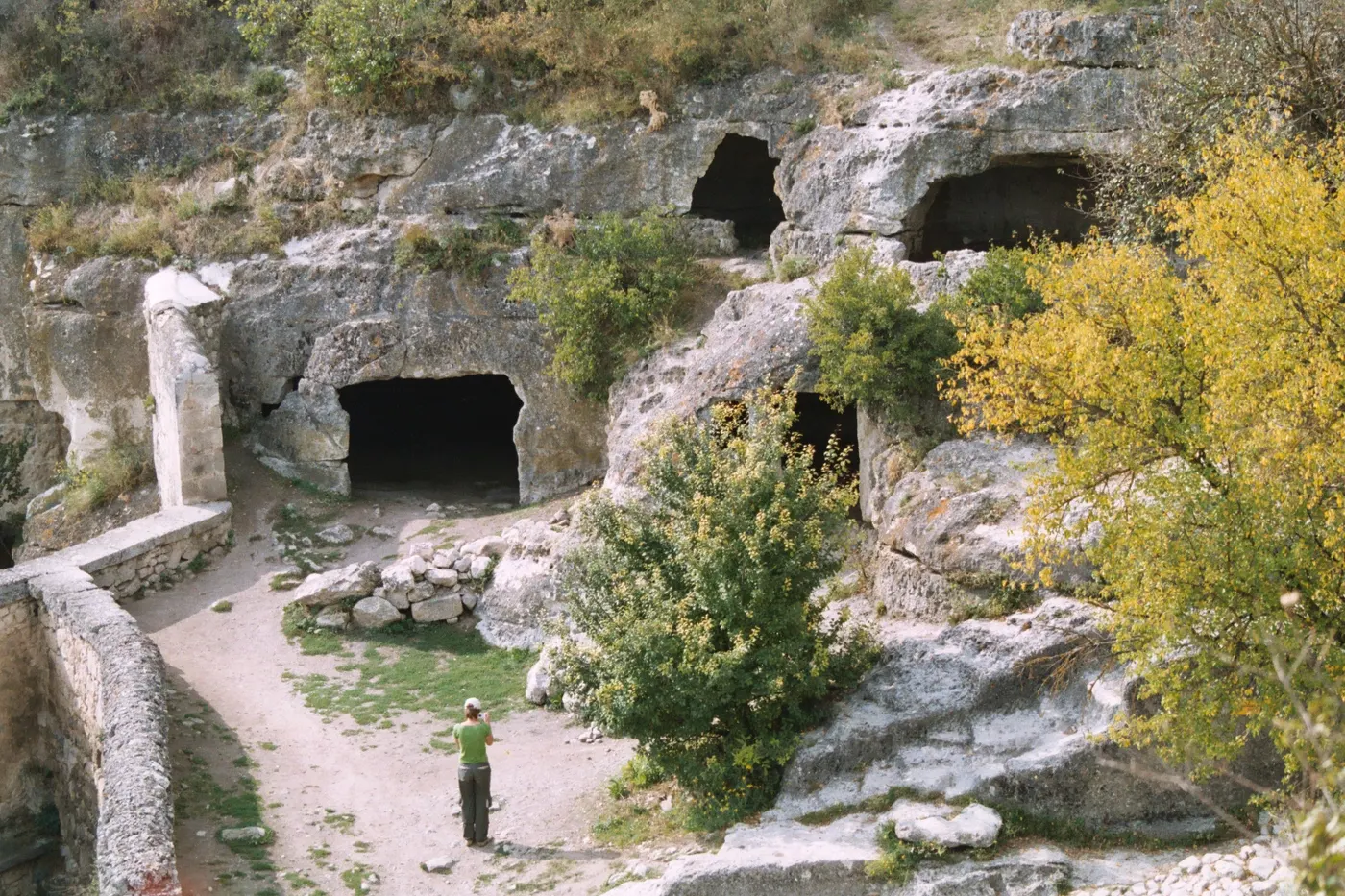
A cave town on a Crimean plateau, inhabited from the sixth century and abandoned in the nineteenth. The name means Jewish fortress — the Karaites were the last to live here. Houses, cisterns, a prison and the mausoleum of the khan's daughter Canike Hanım are cut into the rock. Beside it lies the Karaite cemetery of Balta Tiymez, "the axe shall not touch" — a protected oak grove where felling was absolutely forbidden, which is why it outlived every wood around it.
Comments
No comments yet. Be the first.