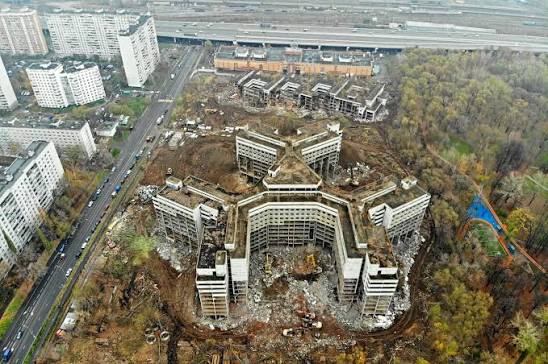
The Khovrino Hospital
The Khovrino Abandoned Hospital (colloquially known as "HZB" or "The Umbrella") was a notorious Soviet mega-scale unfinished complex, formerly situated at 2 Klinskaya Street in the Khovrino District of northern Moscow. Built in a monumental modernist and brutalist architectural style, the 1,300-bed facility famously formed a three-pointed star from the air that precisely mirrored the international biohazard symbol and the Umbrella Corporation insignia from Resident Evil. For over three decades, the derelict complex served as the ultimate urban exploration mecca in post-Soviet Russia, cultivating extensive dark urban mythology before its complete demolition in late 2018.
The legend
Danger Level: Orange (Documented fatalities of dozens of trespassers inside the hazardous ruins that generated dark myths of blood cults and covert police raids) Among Russian urban explorers and creepypasta communities, the hospital was widely mythologized as a portal to hell. The most persistent legend claimed that a satanic cult named "Nemostor" established an underground headquarters inside the unlit subterranean vaults during the 1990s, carrying out ritual sacrifices of stray animals and wandering civilians. According to the folklore, following a string of disappearances, elite police and OMON commandos cornered the cultists inside the lowest subterranean gallery, dynamited the exits or opened sewer conduits, and deliberately drowned the entire group beneath rising black water. The flooded subterranean floors were subsequently revered as a watery tomb haunted by screaming phantoms. Another prominent piece of lore centered on the eighth-floor memorial to "Kray"—a shrine dedicated to 16-year-old Alexey Krayushkin, who leaped down an open elevator shaft in 2005 following unrequited love. Stories also claimed that sadistic saboteurs rigged the corridors with tripwires over concealed chasms and that the flooded lowest basements concealed secret entrances to the classified Metro-2 network.
What actually happened?
Construction commenced in 1980, slowed to a crawl by 1985, and was definitively abandoned in 1992. The demise of the facility was rooted purely in catastrophic geological miscalculation and municipal budget failures: the colossal structure was erected directly over the swampy, culverted floodplain of the subterranean Likhoborka River. Subsurface soil instability and the sheer mass of the reinforced concrete caused severe differential settlement. Rising groundwater permanently inundated the two-tier sub-basements, structural pillars developed stress fractures, and the entire complex began sinking unevenly by several centimeters annually. The myth of the "Nemostor" cult and their drowning by paramilitary forces was entirely fabricated by late-1990s youth subcultures and early internet message boards; municipal police records and coroners' archives hold zero evidence of such an armed raid or mass deaths. The genuine physical fatalities, however, were starkly real: unmonitored elevator shafts, missing safety barricades, and pitch-black stairwells led to fatal falls among young trespassers; homeless individuals froze to death during brutal winters, and exposed, rusted reinforcing rebar made any fall catastrophic. In October and November 2018, the Moscow municipal government completely demolished the hazardous ruin using high-reach excavators, clearing the ground to build contemporary residential towers.
History
The state-of-the-art facility was drafted by Soviet architects I. Yadrov, A. Saukke, and I. Kosnikova. The biohazard-like tri-radial configuration was conceived as an avant-garde healthcare design aimed at streamlining staff transit times between surgical wings. Following the formal freeze between 1985 and 1992, perimeter security lapsed, turning the vacant concrete carcass into a multi-decade playground for EMERCOM rescue drills, tactical paint-ballers, graffiti artists, and subcultures. By the mid-2000s, perimeter fences, barbed wire, and private security guards were deployed, though trespassers persistently breached the barriers. In December 2016, Moscow authorities formally slated the blighted site for destruction. Demolition crews mobilized heavy hydraulic machinery on October 23, 2018, reducing the monolithic landmark to rubble within weeks.
Where is it?
2 Klinskaya Street, Khovrino District, Northern Administrative Okrug, Moscow, Russia; situated opposite Grachyovka Park, near the Grachyovskaya railway station and the Khovrino metro station.
Can you visit?
Visiting the Khovrino Hospital is impossible today, as the entire structure was razed to the ground in late 2018. The site, along with its flooded subterranean levels, was filled, stabilized, and redeveloped into modern residential apartment blocks and municipal transit infrastructure. The former wasteland is now a fully urbanized residential neighborhood with public walkways, streets, and playgrounds, accessible alongside the neighboring public grounds of historic Grachyovka Park.
Bodie
A California gold-rush town that peaked near 10,000 residents and emptied by the early 20th century. It is kept in a state of "arrested decay" — houses still hold the belongings their owners walked away from.

Comments
No comments yet. Be the first.