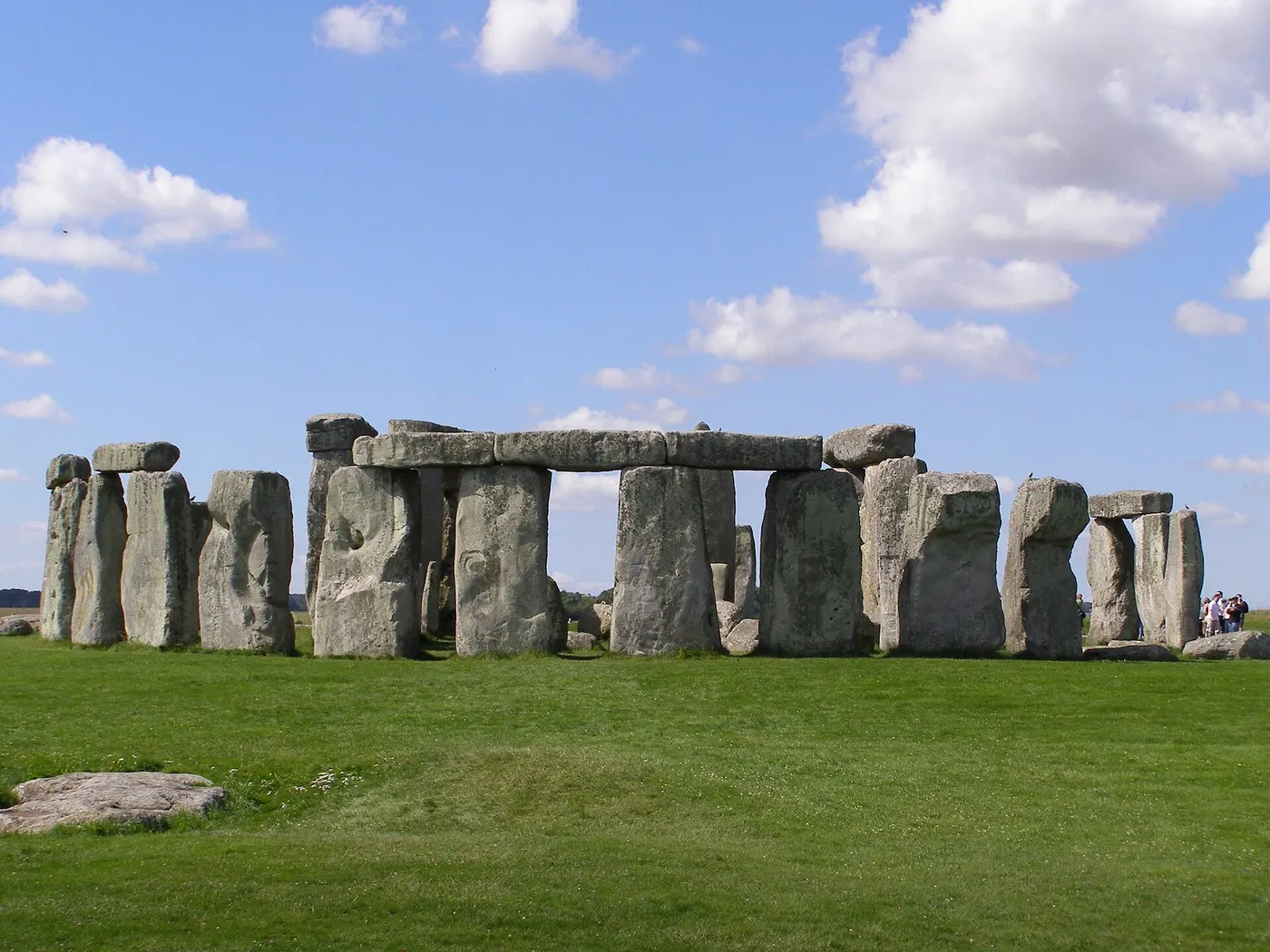
Stonehenge
Stonehenge is a world-renowned prehistoric megalithic monument situated on Salisbury Plain in Wiltshire, southern England. Constructed between 3000 and 1500 BC, the earthwork and stone circle complex consists of an outer ring and inner horseshoe of massive sarsen silcrete monoliths joined by lintels via tongue-and-groove and mortise-and-tenon joints, along with smaller volcanic bluestones. Inscribed as a UNESCO World Heritage Site, it remains the ultimate archaeological icon of the British Isles, historically enveloped in folklore involving Celtic druids, the wizardry of Merlin, extraterrestrial beacons, and modern conspiratorial "1954 construction" hoaxes.
The legend
Danger Level: Green (A secure, heavily managed prehistoric monument posing zero physical threat) Medieval legends attributed the construction of the monument to the wizardry of Merlin; 12th-century chronicler Geoffrey of Monmouth wrote that Merlin magically levitated the "Giants' Dance" stone circle from Ireland to Salisbury Plain to serve as a memorial for fallen British nobles. In the 17th and 18th centuries, antiquarians John Aubrey and William Stukeley cultivated the enduring romantic myth that the monument was a blood temple built by Celtic Druids for human sacrifice atop the central "Altar Stone." 20th-century ufology and New Age lore transformed the circle into an extraterrestrial landing beacon, an acoustic interdimensional stargate, and a zero-point energy grid station engineered by survivors of Atlantis. In the 2010s, a viral internet conspiracy surfaced alleging that authentic 1950s documentary photographs showing mobile cranes and concrete mixers were proof that Stonehenge was an outright historical hoax, fabricated from scratch by the British military and government in 1954 to generate post-war tourism revenue.
What actually happened?
Rigorous multi-disciplinary field surveys, radiocarbon dating, and geochemical fingerprinting have established the objective history: Neither Druids nor Merlin: The monument was engineered in phased stages by Neolithic and Early Bronze Age agrarian societies between 3000 and 1600 BC. Celtic culture and the Druidic priesthood did not emerge in the British Isles until the Iron Age (mid-1st millennium BC)—roughly 1,500 to 2,000 years after the primary stone megaliths were placed. Excavations show zero evidence of institutional Iron Age human sacrifice inside the ring. Petrographic sourcing and transport: In 2020, geochemical provenance studies led by Professor David Nash traced the primary 20-to-30-ton sarsen megaliths to West Woods on the Marlborough Downs, 25 kilometers to the north; they were hauled over land using timber sledges, rollers, and greased runners. The smaller 2-to-4-ton spotted dolerite and rhyolite "bluestones" were quarried in the Preseli Hills in Pembrokeshire, southwest Wales, transported roughly 220 to 240 kilometers via maritime coastal cabotage, rivers, and overland dragging—demonstrating sophisticated Late Neolithic logistical capability. Monumental function: Stonehenge functioned as an ancestral burial ground and solstitial astronomical observatory. Its earliest phase (the Aubrey Holes, c. 3000–2500 BC) served as the largest cremation cemetery in Neolithic Britain. The primary spatial axis aligns with the solstices: the summer solstice sunrise and winter solstice sunset. Archaeological work directed by Mike Parker Pearson at neighboring Durrington Walls revealed that the winter solstice was the primary cultural focus: isotopic analyses of massive deposits of pig and cattle bones demonstrate seasonal winter slaughter and midwinter feasts drawing communities from across the British mainland. The "1954 Hoax" debunked: Stonehenge is documented across medieval cartularies, 16th-century engravings, William Turner and John Constable paintings (1835), and late-19th-century photography. Between 1901 and 1964, conservation engineers and archaeologists (including William Gowland in 1901 and Richard Atkinson in 1958) utilized heavy mobile cranes to lift fallen lintels, straighten leaning uprights, and set precarious sarsens into hidden concrete footings to prevent catastrophic collapse. Modern conspiracy theorists intentionally mislabeled archival stabilization photography as "initial construction."
History
Construction commenced around 3100 BC with the excavation of an outer circular ditch and bank measuring 110 meters in diameter, accompanied by the 56 Aubrey Holes. Around 2500 BC, the site was transformed: builders raised the outer circle of 30 sarsen uprights capped by horizontal lintels, along with an inner horseshoe of five towering free-standing trilithons reaching 7.3 meters in height. Modifications continued until roughly 1600 BC before activity ceased. During the Middle Ages, the site weathered and suffered piecemeal stone robbing. In 1915, local barrister Cecil Chubb bought the dilapidated monument at auction for £6,600 and formally deeded it to the British nation in 1918 under the condition that it remain publicly preserved. Conservatorship shifted to the state (managed today by English Heritage), and in 1986 it was inscribed onto the UNESCO World Heritage List alongside the Avebury henge complex.
Where is it?
Salisbury Plain, Wiltshire, South West England, United Kingdom; situated approximately 3 kilometers west of Amesbury and 13 kilometers north of Salisbury, adjacent to the A303 highway corridor.
Can you visit?
Yes, Stonehenge is open daily year-round under the stewardship of English Heritage. Entry requires timed-admission ticketing, strongly recommended to be reserved online in advance. The visit originates at the modern Stonehenge Visitor Centre, which houses an extensive museum gallery and reconstructed Neolithic houses; visitors reach the stones via an electric shuttle transit or a 25-minute pedestrian walk across the grassland. Standard ticket holders circulate along a designated perimeter path situated 5 to 15 meters from the megaliths to prevent soil erosion and graffiti. For travelers wishing to step directly between the stones, English Heritage operates the specialized "Stone Circle Experience" (exclusive out-of-hours dawn and twilight tours requiring advance booking). During the summer and winter solstices, open-access celebrations are held, allowing the public, modern pagans, and tourists to walk among the stones free of charge.
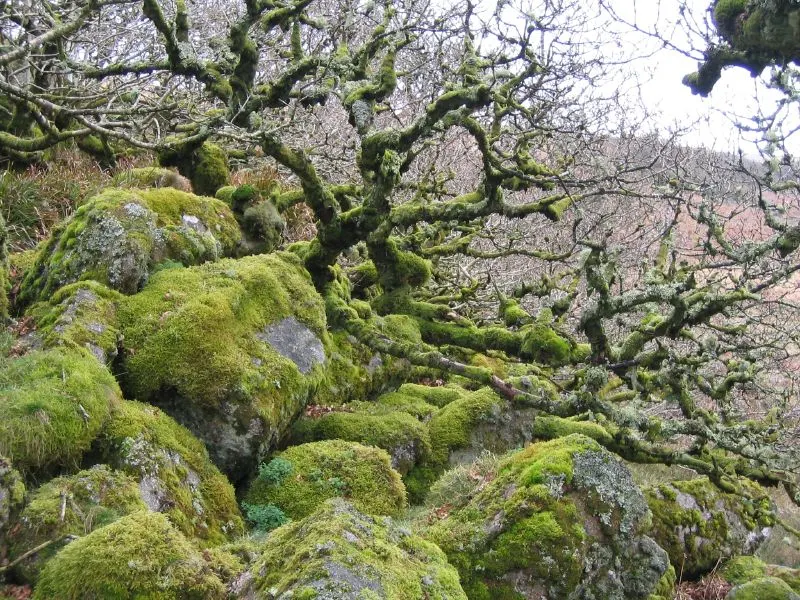
Wistman's Wood
A tiny grove of dwarf oaks on Dartmoor, growing straight out of granite boulders and covered entirely in moss and lichen. The trees are wind-twisted past recognition and there are gaps between the stones deep enough to swallow a person. The name is traced to the dialect word wisht — eerie, enchanted. It is thought to be one of the last remnants of the forest that covered Dartmoor before the Bronze Age.
Comments
No comments yet. Be the first.