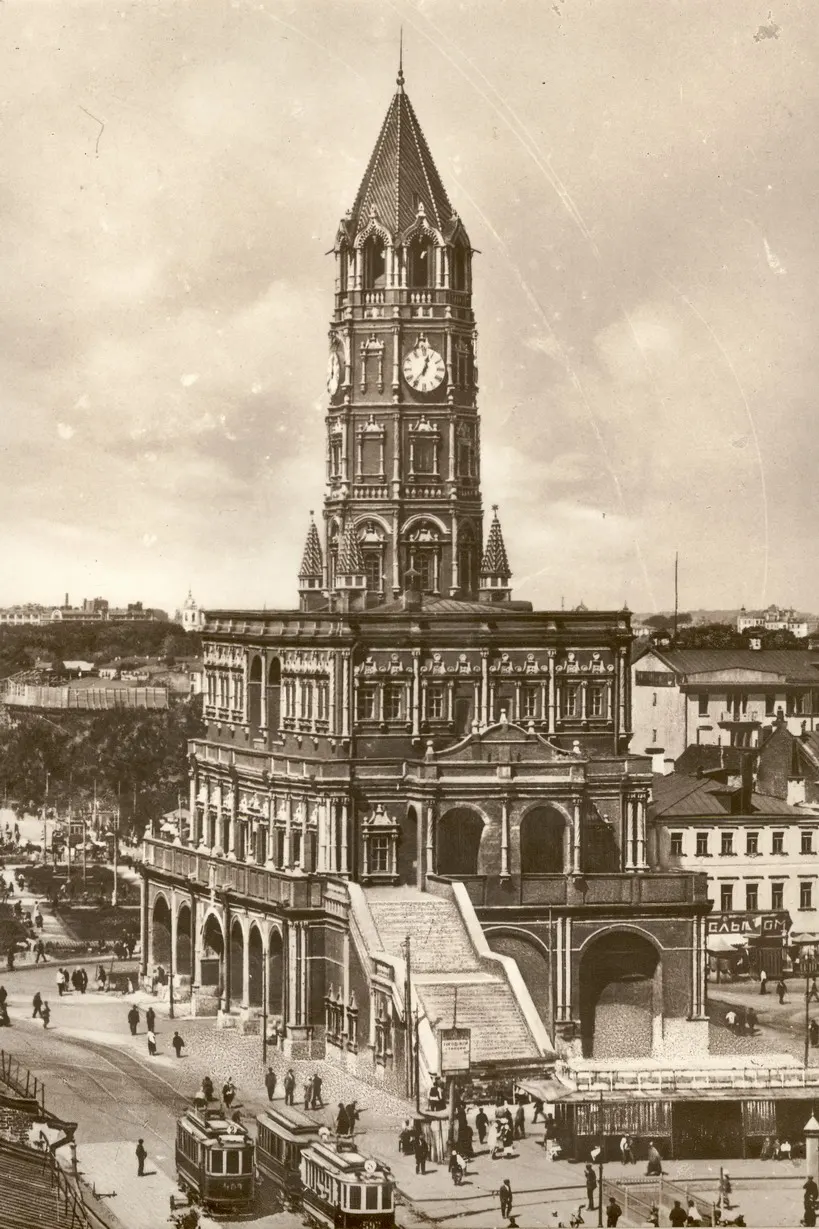
The Sukharev Tower and Jacob Bruce
The Sukharev Tower was a masterpiece of late-17th-century Russian civil architecture, formerly standing at the junction of Moscow's Garden Ring, Sretenka Street, and Prospekt Mira. Commissioned by Peter the Great and designed in the ornate Naryshkin Baroque style, the 60-meter-tall red-and-white monument functioned as a ceremonial city gate, the administrative birthplace of the Russian Imperial Navy, and the nation’s first astronomical observatory. In folk memory, the landmark is permanently tied to one of Peter's closest intellectual confidants, Field Marshal Jacob Bruce, who was mythologized as the supreme warlock and sorcerer of the Russian Empire.
The legend
Danger Level: Green (A lost historical monument wrapped in urban folk mysticism with zero physical threat) For over two centuries, Muscovite folklore portrayed Jacob Bruce as the "Sorcerer of the Sukharev Tower" and Russia’s Faust. Locals whispered that unholy lights glowed inside the tower’s uppermost chambers every night, where Bruce purportedly distilled elixirs of eternal youth, forged gold from lead, cast astrological horoscopes predicting the rise and fall of dynasties, and launched mechanical flying birds into the darkness. Popular gossip credited him with creating a mechanical silver serving maid and flash-freezing summer lakes in July for open-air ice skating. The central myth alleged that Bruce concealed his forbidden occult knowledge inside the "Black Book"—a grimoire dictated by Lucifer and immured deep within the foundation walls of the tower. In the 1930s, an urban myth arose claiming Joseph Stalin ordered the tower meticulously dismantled brick by brick under the watchful eyes of secret police agents specifically to recover Bruce’s occult library and alchemical manuscripts. Following its destruction, legend claims the phantom of Bruce wanders the Garden Ring searching for his vanished sanctuary.
What actually happened?
Jacob Bruce (James Daniel Bruce, of Scottish royal lineage) was never an occultist, but rather one of the most brilliant scientific minds, polymaths, and military engineers of the early Russian Enlightenment. Serving as Grand Master of Artillery and President of the Mining and Manufacturing Colleges, Bruce revolutionized Russian metallurgy, standardized artillery calibers, reformed coinage, and mapped the Russian interior from Moscow to the Black Sea. His "sorcery" was simply applied empirical science misunderstood by a superstitious public: in 1701, Peter I placed the School of Mathematical and Navigational Sciences inside the tower, where Bruce constructed Russia’s first astronomical observatory outfitted with telescopes, celestial globes, and quadrants. To illiterate early-18th-century citizens, an intellectual tracking star orbits through brass optics and conducting chemistry experiments appeared to be practicing black magic. The mythical "Black Book" never existed: Bruce owned an extraordinary 1,500-volume scientific library covering mathematics, optics, ballistics, and botany, which he bequeathed upon his death to the St. Petersburg Academy of Sciences, where it remains cataloged today. The tower’s 1934 demolition had zero occult connection: it stood squarely in the center of the Garden Ring, strangling burgeoning automotive and tram networks. Despite impassioned conservation campaigns led by prominent architects (including Alexey Shchusev and Igor Grabar) who drafted plans to divert traffic around the monument, Soviet leadership under Stalin and Lazar Kaganovich demolished it purely for road-widening under the 1935 General Plan for the Reconstruction of Moscow.
History
The tower was erected between 1695 and 1701 on the site of the old wooden Sretensky Gate of the Zemlyanoy Gorod, designed by architect Mikhail Choglokov. It was named in honor of Colonel Lavrenty Sukharev, whose streltsy regiment remained loyal to teenage Tsar Peter during Sophia Alekseyevna's armed rebellion in 1689. Beginning in 1701, it housed the Navigation School, training Russia’s earliest generations of naval officers, cartographers, and geodesists. In the 19th century, with the completion of the Mytishchi water pipeline, its upper tier was converted into a colossal iron reservoir providing municipal water. During the 1920s, the structure housed the Moscow Municipal Museum. On August 17, 1933, Soviet authorities declared the landmark an obstruction to modern transit; between April and June 1934, the monument was systematically demolished, with much of the masonry crushed into ballast for the Moscow Metro.
Where is it?
Bolshaya Sukharevskaya Square, Moscow, Russia; situated directly at the intersection of the Garden Ring (Sadovaya-Spasskaya and Sadovaya-Sukharevskaya streets) and Sretenka Street / Prospekt Mira.
Can you visit?
The tower itself was destroyed in 1934 and no longer stands. However, the site is a major, freely accessible public square and pedestrian thoroughfare in central Moscow. During utility renovations in 2006, archaeologists excavated the massive white-stone foundations beneath Bolshaya Sukharevskaya Square; sections of the original sub-surface masonry were preserved within the pedestrian underpass, and the footprint of the tower’s perimeter was paved in contrasting stone on the plaza above. A commemorative marker and bas-relief stand nearby. Visitors can also tour Jacob Bruce's preserved country estate, Glinki, located in the Moscow region, where the polymath spent his retirement years conducting research.
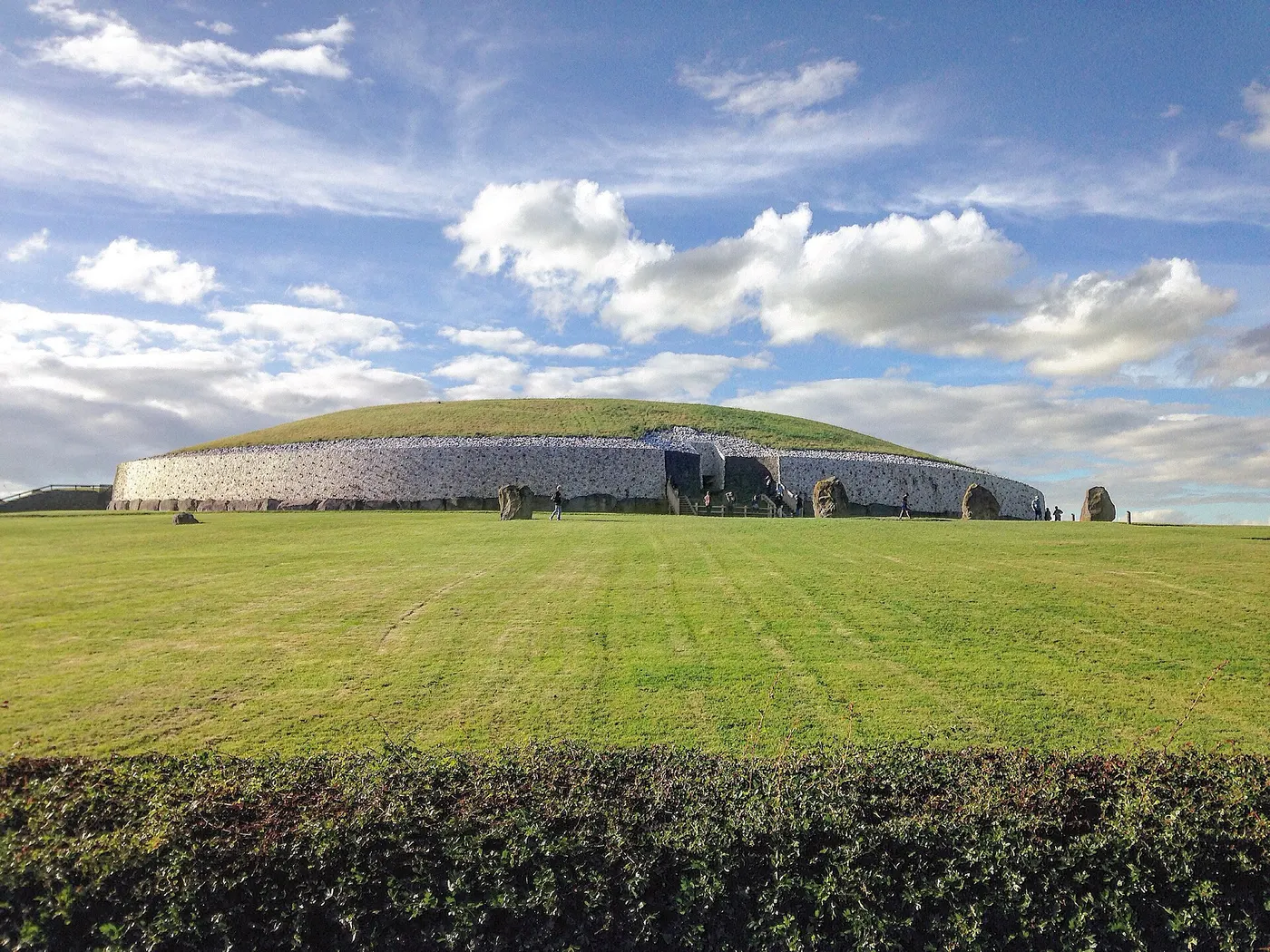
Newgrange
An Irish passage tomb built around 3200 BC — older than Stonehenge and the Egyptian pyramids. At the winter solstice a beam of rising sun passes through a narrow opening and lights the chamber deep inside.
Comments
No comments yet. Be the first.