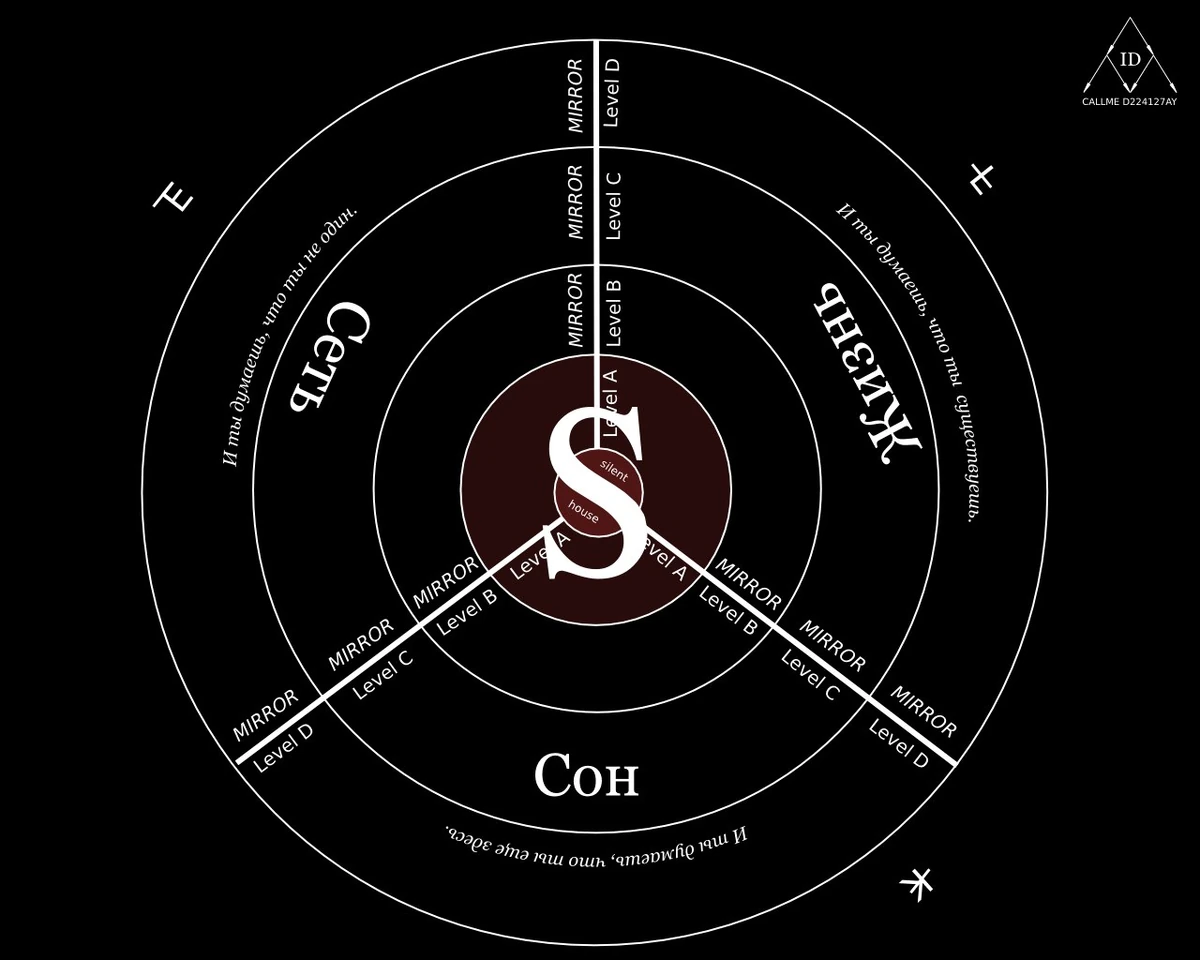
Tikhiy Dom
"Tikhiy Dom" (The Quiet House / Silent House) is the quintessential urban legend of Russian netlore and the netstalking subculture, signifying the mythical, absolute lowest stratum of the Deep Web. Originating in RuNet forum folklore in the early 2010s, the concept depicted a terminal ontological threshold at the "bottom of the Internet" where entry irreversibly severs human consciousness from physical reality. Between 2015 and 2016, this netstalking terminology was appropriated by malicious online actors within VKontakte alternate reality game (ARG) shock circles ("death groups", f57), transforming into a euphemistic metaphor for suicide during the moral panic surrounding the viral "Blue Whale" challenge.
The legend
Danger Level: Orange (A toxic netlore fabrication and psychological manipulation vector that triggered widespread societal moral panic and emotional distress among youth) Between 2011 and 2012, viral infographics outlining the "Levels of the Internet" circulated across Russian-language imageboards, arranging network depth from surface Level D down to esoteric Level A. Beyond the standard indexed web, the darknets (Tor/I2P), and the "Mariana Web" lay speculative strata: the "Frozen Web" and the "Primarch System." At the terminus sat Level 8: the "Quiet House." Folklore asserted that standard networking protocols could never resolve its address; access supposedly required nonexistent quantum cryptographic keys, custom firmware, or trances induced by sensory biofeedback. The Quiet House was portrayed not as a web server, but as a digital singularity—an informational void of total sensory deprivation. Lore held that netstalkers reaching it suffered cognitive obliteration, entering catatonic stupors or vanishing physically from reality, leaving only an empty chair behind. By 2015–2016, the archetype took a destructive turn: administrators of clandestine VKontakte shock groups ("f57", "Sea of Whales") rebranded the "Quiet House" into an ethereal afterlife of ultimate tranquility. Impressionable adolescents were led to believe that navigating the 50-day "Blue Whale" challenge—waking at 4:20 AM, enduring psychological isolation, self-harming, and executing instructions—would permit "chosen whales" to escape an uncaring physical world and pass into the eternal serenity of the Quiet House.
What actually happened?
The "Quiet House" never possessed technical reality; its lifecycle represents a transition from conceptual internet trolling into acute social hysteria: The Netstalking Hoax (Synthetical Science): In 2011, members of the pioneering Russian netstalking collective "Synthetical Science" operating on the imageboard 2ch.hk (/b/ and /sn/ boards) drafted the "Internet Levels" diagram and conceived the "Quiet House." Designed as an exercise in "meme engineering," the objective was to craft viral creepypasta lore to encourage tech enthusiasts to learn network scanning, port probing, OSINT techniques, and open-directory exploration. In 2013, the creators publicly admitted the fiction. The global internet exhibits no "hidden subterranean tiers": network architecture relies uniformly on the standard TCP/IP protocol suite, standard DNS resolution, and BGP routing topologies. Co-optation into shock ARGs (f57): In late 2015, following the publicized suicide of a teenager in Ussuriysk, dozens of viral shock communities emerged across VKontakte. Troll administrators—most notably Philipp Budeikin ("Philipp Lis")—appropriated netstalking terminology, cryptic numerology, whale imagery (borrowed from rock lyrics and teen fiction), and the "Quiet House" motif to craft edgy alternate reality games (ARGs). Their core motivations were audience growth, commercial monetization of ad space, and malicious trolling directed at vulnerable youth. The "Blue Whale" moral panic: In May 2016, an investigative article by Galina Mursalieva titled "Death Groups" in Novaya Gazeta linked independent youth tragedies across Russia to a single coordinated conspiracy driven by hashtags such as #tikhiydom, #f57, and #bluewhale. Subsequent academic inquiries by anthropologists and folklorists at RANEPA (directed by Dr. Alexandra Arkhipova) demonstrated that a sprawling coordinated death cult was a modern urban legend fueled by media panic: the overwhelming majority of participants deployed the hashtags out of curiosity, peer dare games, or online trolling, while youth suicides stemmed from established socio-psychological factors rather than mythical Deep Web software.
History
In 2010, amid the collapse of the original 2ch.ru and the launch of 2ch.so, early Russian netstalking discovery threads began organizing. In 2011, "Synthetical Science" seeded the "Internet Levels" diagram and the Quiet House myth. By 2013, the original myth had waned, and netstalking matured into analytical disciplines (OSINT, open-port indexing). In November 2015, Philipp Budeikin founded the VKontakte shock group "f57," distributing transgressive content framed by the #tikhiydom hashtag. In May 2016, sensational national press exposés triggered federal crackdowns. In November 2016, Budeikin was arrested in Solnechnogorsk; in July 2017, the Tobolsk District Court sentenced him to three years and four months in a penal colony for inciting self-harm. By the close of the decade, the Quiet House had reverted to its original status: a nostalgic early-RuNet netlore relic and a case study in digital anthropology.
Where is it?
Russia; the archetype was synthesized within the virtual architectures of Russian anonymous imageboards (principally 2ch.hk) and early VKontakte communities. Physical infrastructural anchors include historic RuNet server nodes: VKontakte data hubs in Saint Petersburg (Tsvetnaya Street, Selectel facilities), while the geographic node of the destructive social media chapter was the town of Solnechnogorsk in Moscow Oblast (the residence and arrest site of f57 administrator Philipp Budeikin).
Can you visit?
Accessing the "Quiet House" is impossible because no such server node, encrypted protocol, or esoteric domain exists within the architecture of the Internet. Any client software, "quantum scripts," or direct URLs circulating online claiming to grant access are trojan malware or netlore pranks. All social media groups and message boards trading under the banners of "Tikhiy Dom," "f57," or "Blue Whale" are permanently blocked by regulatory authorities and platform safety teams under anti-harm statutes. Historical materials may be consulted strictly for academic purposes via peer-reviewed folkloric papers and digital subculture archives.
The Dybbuk Box
A wine cabinet listed on eBay in 2003 with a long description: supposedly it had belonged to a Holocaust survivor and contained a possessing spirit from Jewish folklore. The lot was resold repeatedly, each owner adding fresh misfortunes to the listing, the auction spread across the internet and eventually became a Hollywood film. In 2021 the original seller, the writer Kevin Mannis, publicly acknowledged that the whole thing was fiction he had written — a literary project that accidentally became a modern legend.

Comments
No comments yet. Be the first.