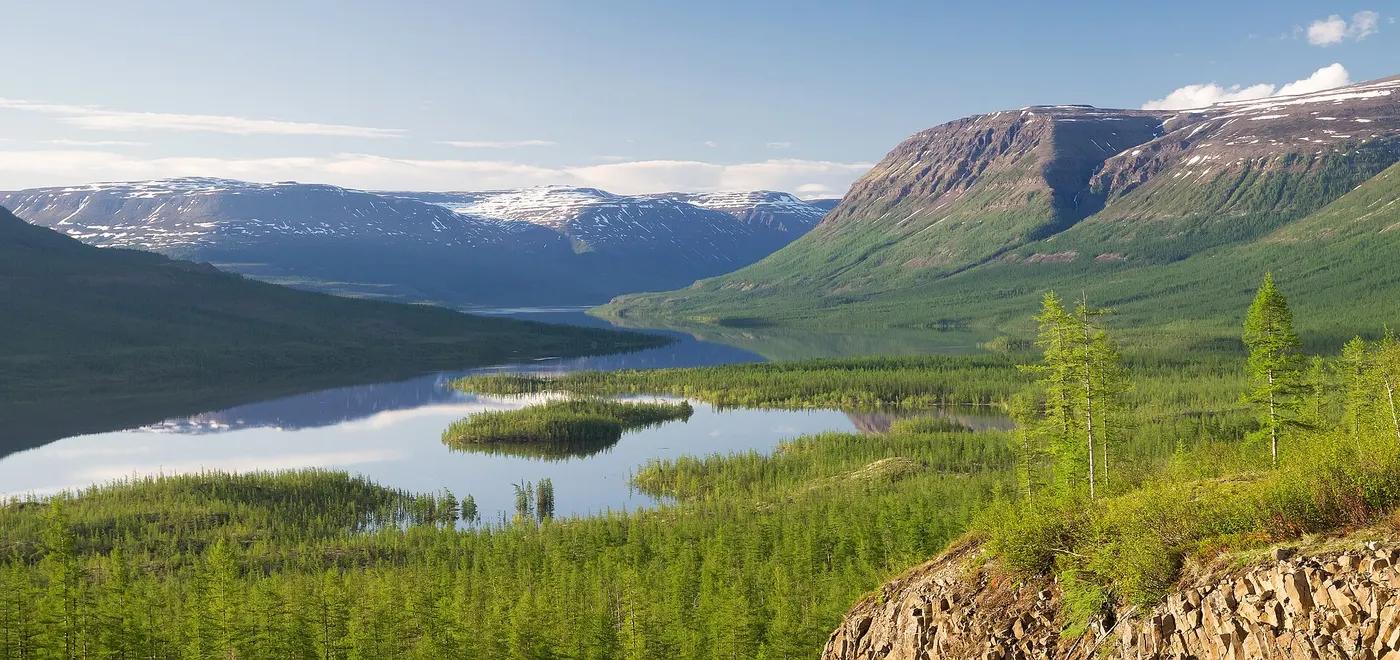
The Putorana Plateau
The Putorana Plateau is an immense basaltic mountain massif covering roughly 250,000 square kilometers (comparable in size to the United Kingdom), situated in northwestern Central Siberia beyond the Arctic Circle. Designated a UNESCO World Heritage Site, it is a pristine subarctic wilderness characterized by deep jagged canyons, thousands of waterfalls, and fjord-like tectonic lakes, recognized as one of the most remote places on Earth.
The legend
Danger Level: Orange (Extreme subarctic wilderness with documented survival fatalities that fostered fringe myths of Hyperborean ruins and secret extraterrestrial bases) Fringe theorists and esoteric circles frequently identify the Putorana Plateau as the lost cradle of mythical Hyperborea or a frozen "Siberian Atlantis." Proponents claim the flat-topped, stepped mountains are artificial megalithic ziggurats and pyramids engineered by a prehistoric civilization using precision masonry. The plateau is also labeled an active paranormal vortex: UFO enthusiasts allege that covert extraterrestrial outposts, temporal anomalies, and dimensional portals exist inside its uncharted canyons. The disappearances of solo trekkers in the deep taiga are commonly romanticized as alien abductions or spiritual vanishing acts rather than wilderness survival failures.
What actually happened?
The alleged "pyramids" and "cyclopean walls" are textbook geological features of the Siberian Traps. Roughly 252 million years ago, massive volcanic fissure eruptions produced continental flood basalts linked directly to the Permian-Triassic extinction event. Successive layers of basalt solidified sequentially, giving rise to stepped topography—the term "trap" stems from the Swedish word for staircase. As cooling magma contracted, it formed columnar and orthogonal jointing. Over millions of years, freeze-thaw cycles fractured the rock into neat geometric slabs and boulders that human pareidolia misinterprets as artificial masonry. Compass deviations are caused by dense natural concentrations of magnetite within basalt, not paranormal energy fields. Disappearances in the region stem from brutal physical reality: absolute absence of roads and infrastructure across hundreds of miles, flash floods, unstable scree slopes, subzero Arctic weather shifts, and dense brown bear populations.
History
The plateau was historically inhabited by indigenous Evenki and Dolgan peoples, who regarded the summits as the dwelling places of powerful spirits and observed taboos against ascending certain canyons. Western scientific charting began in the 1840s with explorer Alexander Middendorff. In the 1920s, geologist Nikolay Urvantsev mapped the western approaches, directly leading to the discovery of colossal copper-nickel deposits and the founding of the industrial city of Norilsk. In 1988, the Putoransky State Nature Reserve was formally created to safeguard pristine subarctic taiga and the rare Putorana bighorn sheep. The plateau was inscribed as a UNESCO World Heritage Site in 2010.
Where is it?
Taymyrsky Dolgano-Nenetsky and Evenkiysky Districts, Krasnoyarsk Krai, Russia; situated east and southeast of the city of Norilsk in northern Siberia.
Can you visit?
Yes, but traveling here demands extensive wilderness expedition experience and significant logistics budgets. The primary gateway is the city of Norilsk. During summer, the western perimeter (Lake Lama) can be reached via motorboats navigating regional river systems, while access to the deep central canyons requires chartered helicopters. Entering the protected Putoransky Nature Reserve requires advance permits issued by the Zapovedniki Taimyra administration. Unassisted expeditions venturing into the backcountry without registering with EMERCOM, carrying satellite communications, and maintaining bear defense measures are life-threatening.
The Mad Gasser of Mattoon
In September 1944 residents of Mattoon, Illinois, began reporting the same thing to police: a sweetish smell in the house, nausea, numbness in the legs, a paralysing weakness. Around two dozen cases were logged in a fortnight. Police, the FBI and chemists found no substance, no traces and no man. The standard explanation is a wartime episode of mass psychogenic illness amplified by the local paper; the alternative points at emissions from a nearby plant. Neither is proven, and the case is a textbook fixture in social psychology.
Comments
No comments yet. Be the first.