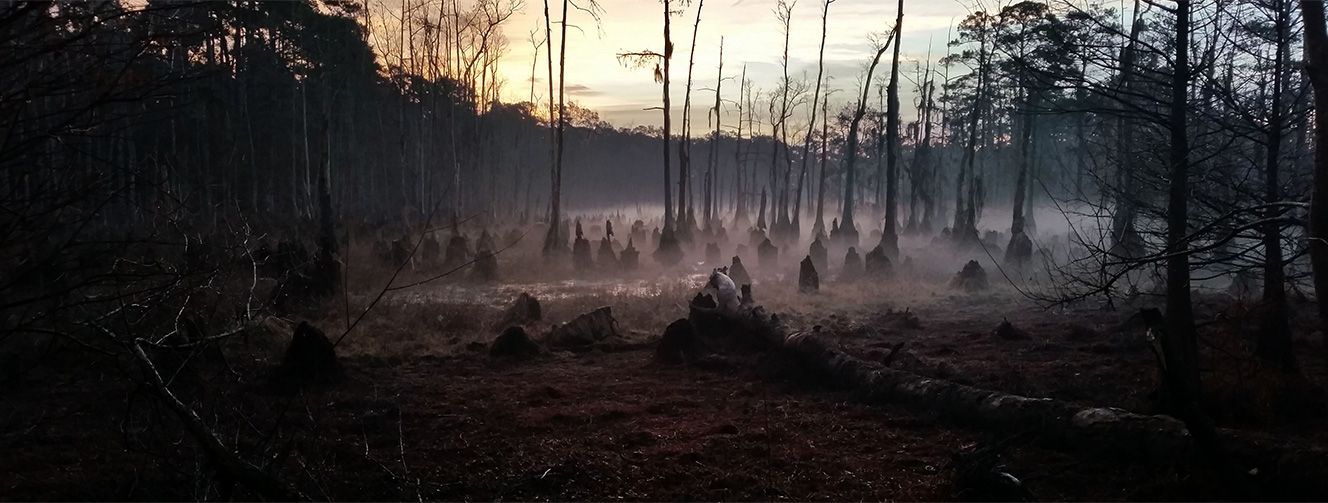
The Shushmor tract
The Shushmor Tract is an isolated, swampy forest wilderness situated within the river basins of the Polya, Voymega, and Buzha rivers along the boundary of the Shatursky District (Moscow Oblast) and Gus-Khrustalny District (Vladimir Oblast) in the heart of the Meshchera Lowlands. Comprising peat bogs, dense moss woodlands, and pine ridges, the territory gained fame in the late 20th century as the Moscow region's oldest anomalous hotspot, earning the moniker of the "Meshchera Bermuda Triangle" due to enduring lore regarding disappearing travelers and a forgotten pagan megalithic shrine.
The legend
Danger Level: Yellow (Legitimate wilderness hazards: deep peat quagmires, blown-down timber, disorientation, and high adder populations romanticized into an occult vortex) According to regional ufological lore and sensationalist press, Shushmor is the oldest geopathic zone in Central Russia, with roots supposedly dating back to the 12th century. The core mystery involves a lost pagan megalithic shrine built by the indigenous Finno-Ugric Meshchera tribe dedicated to a serpentine deity (Snake God Ur). Folklore describes this shrine as a six-meter-wide stone hemisphere or stepped altar of polished granite blocks enclosed by a henge of megalithic stone pillars hidden deep in the marshes. The legend alleges that between 1885 and 1897, dozens of travelers vanished along the historic Kolomna–Vladimir postal tract crossing the bogs—including entire merchant carts, mail carriages, surveyors, and imperial police detachments. Late-20th-century sensationalist accounts linked the zone to interdimensional rifts, claiming that magnetic compass needles spin erratically, radio signals fade, ferns grow up to two meters in height, and pine trunks twist into unnatural corkscrews under the influence of telluric earth currents.
What actually happened?
Archival research, historical scrutiny, and geographical expeditions systematically debunked the Shushmor myth: Literary origin of the legend: The modern concept of the "Shushmor anomalous zone" was fabricated during the 1970s and 1980s by amateur local historian and physics teacher Nikolay Akimov from the nearby town of Roshal. Akimov fused genuine regional folklore concerning historic highway robberies with speculative interpretations, inventing the non-existent deity "Snake God Ur" (a moniker possessing zero linguistic basis in Uralic languages). The story was subsequently sensationalized by 1990s tabloids and amateur cryptozoology groups. The 19th-century disappearances: Official imperial police registries of the Ryazan and Vladimir governorates reveal zero records of vanishing post carriages or surveyors. The historic Kolomna tract was a treacherous corduroy log road traversing impassable wilderness. The area did suffer from a sinister reputation, but it was purely criminal: the trackless peatlands provided sanctuary for runaway penal convicts and highway robbers who targeted solitary merchants, concealing victim remains inside bottomless peat quagmires. The missing megalithic altar: Over four decades of searches by cavers, cartographers, and academic archaeologists, not a single artificial stone hemisphere, dolmen, or megalithic ring was ever located. The scattered granite stones occasionally encountered across the moss flats are mundane glacial erratic boulders deposited during the Quaternary glaciations from Karelia and the Kola Peninsula. Botanical and magnetic realities: The "giant ferns" are ordinary ostrich ferns (Matteuccia struthiopteris), which regularly attain heights of nearly two meters in shaded, nutrient-rich peat wetland environments. The twisted pine trunks ("drunken forest") stem from common vegetative trauma: infections by pine twist rust fungi (Melampsora pinitorqua) combined with cryogenic soil heaving across saturated peat beds. Slight local compass deviations are attributable to shallow deposits of bog iron ore (limonite), ubiquitous throughout the Meshchera river bottoms.
History
Prior to the arrival of Slavic settlers in the 10th and 11th centuries, the Meshchera basin was inhabited by indigenous Uralic tribes who practiced animistic nature veneration, maintaining seasonal reverence for non-venomous grass snakes. Between the 17th and 19th centuries, an unpaved commercial cart track connected Kolomna to Vladimir across the swamp margin. In the mid-19th century, commercial peat extraction commenced to fuel the textile mills of the Morozov family. In the 1930s, the nearby town of Roshal developed into a major chemical and gunpowder manufacturing hub. Paranormal tourism surged following local press publications in the regional paper Leninskaya Shatura between 1989 and 1993. Throughout the 1990s and 2000s, dozens of field surveys combed the Polya River basin and the abandoned Kurilovo tract, yielding zero anomalous findings and transitioning Shushmor into an off-road overlanding and bog-hiking route.
Where is it?
Border region of Moscow Oblast (Shatursky Urban Okrug) and Vladimir Oblast (Gus-Khrustalny District), central European Russia; centered on the wilderness of the Meshchera Lowlands north of the Polya River and the settlement of Baksheevo, west of the Buzha River, around the abandoned Kurilovo clearing (roughly 150 to 165 kilometers east of Moscow).
Can you visit?
Yes, the Shushmor Tract is public, unfenced forest land, but it represents an unforgiving wilderness environment. No paved access roads reach the interior: access relies on abandoned logging ruts, washed-out sandy trails, and submerged corduroy causeways navigable only via heavily modified 4x4 vehicles equipped with winches, utility ATVs, or long-distance bog hiking on foot in chest waders. During warm months, hazards include saturated peat quagmires, disorientation within featureless wetlands, insect swarms, and dense populations of venomous common European adders (Vipera berus). During hot, dry summer periods, subterranean peat fires present severe burn and asphyxiation hazards as ground thins out over smoldering root chambers. Hikers require satellite GPS tracking with pre-loaded offline maps, redundant magnetic compasses, high water supplies, repellent, and thick bite-resistant boots.
The Bloop
In 1997 hydrophones belonging to the US National Oceanic and Atmospheric Administration recorded an ultra-low-frequency sound in the South Pacific loud enough to be picked up by sensors three thousand miles apart. Its profile resembled a biological one, and for two decades the Bloop was the leading exhibit for anyone who believes in undiscovered giants in the ocean. NOAA settled it in 2012: an icequake, an iceberg fracturing off Antarctica. The sound stopped being a mystery but remains one of the best-known audio files in internet history.
Comments
No comments yet. Be the first.