 Debunked cases — United States
Debunked cases — United States. 47 places in the catalogue, each with coordinates, the story behind it and a danger level from white to black.
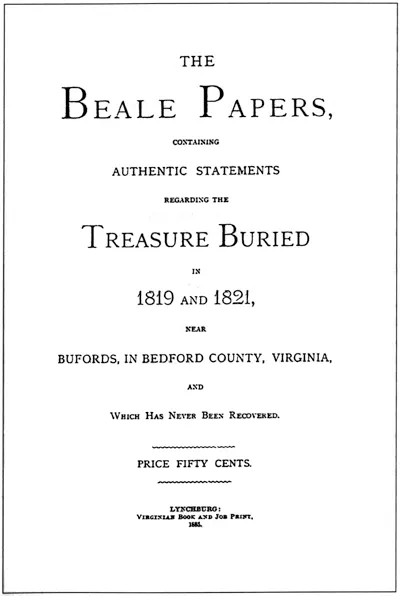
The Beale Ciphers
Bedford County and the city of Lynchburg in Virginia, USA, form the geographic core of one of the most famous cryptographic mysteries in American history. In 1885, an anonymous pamphlet surfaced containing three coded texts purporting to reveal the exact burial site of an enormous cache of gold, silver, and jewels buried in the 1820s by an adventurer named Thomas J. Beale.
The Betz Sphere
On 26 March 1974 the Betz family, walking a burned-over patch of woodland on Fort George Island in Florida, picked up a steel ball some twenty centimetres across. At home it behaved oddly: it rolled about the table, came back to its owner, hummed and made the dog howl. The press announced an alien device. James Randi examined and weighed it and showed that the mystery was an offset centre of gravity and a slightly sloping floor, and that any hollow ball hums. The Navy laboratory at Jacksonville identified the material as 431 stainless steel and concluded it was a ball from a ball mill. The sculptor James Durling-Jones later said he had carried such balls in his van and lost some in exactly that area.
The Balloon Boy
On 15 October 2009 a homemade balloon shaped like a silver flying saucer rose from a garden in Fort Collins. The father, Richard Heene, said his six-year-old son Falcon was inside. The National Guard put helicopters up, Denver airport held flights, and the country watched two hours of live coverage. The balloon landed empty, the boy was found at home in the attic, and that evening in a CNN studio he told his father: you said we did this for the show. Heene, who had appeared in a reality programme about hunting UFOs, pleaded guilty in a Colorado court, served ninety days and paid $36,000 in restitution to the emergency services.
Grovers Mill and the Panic That Wasn't
On 30 October 1938 Orson Welles broadcast his radio version of The War of the Worlds on CBS, with Martians landing at the village of Grovers Mill in New Jersey — and the next morning the papers wrote of millions of Americans fleeing their homes. That second story was taken apart later. The C. E. Hooper ratings service polled five thousand people that evening: about two per cent were listening, and almost none of them called it news. The historians Jefferson Pooley and Michael Socolow showed that the scale of the panic was invented by the newspapers themselves — print was losing advertising to broadcasting and was glad to prove that radio was dangerous. The monument to the Martians at Grovers Mill was put up in 1988.
The Great Moon Hoax
From 25 August 1835 the New York Sun ran a series of six articles reporting that Sir John Herschel, from the Cape of Good Hope, had seen life on the Moon through a new telescope: forests, herds of bison, temples of sapphire and intelligent winged people four feet tall, which he called Vespertilio-homo. The material was presented as a reprint from the Edinburgh Journal of Science, which had by then been out of print for years. The Sun's circulation rose to fifteen thousand, the largest in the world. The author was the reporter Richard Adams Locke, writing satire on the fashionable speculation about inhabitants of the planets; the paper never printed a retraction, and Herschel learned of his discovery by post.
The Paulding Light
On a cleared corridor beneath a power line near Paulding in Upper Michigan, a single light has been seen at the far end on evenings since 1966: by tradition the lantern of a brakeman crushed by a train. The spot became a tourist site and the Forest Service put up a sign. In 2010 students from Michigan Technological University turned a telescope on the light and saw cars in the eyepiece, running on Highway 45 near Dog Meadow eight kilometres away — headlights, sidelights and brake lights all distinguishable. They then drove a car out there and flashed its lights to order over the radio: the light flashed back. An inversion layer over the corridor lifts the headlight beams above the terrain and compresses them into a single point.
The Sailing Stones of Racetrack Playa
On the dry lake of Racetrack Playa in Death Valley, stones weighing up to three hundred kilograms leave furrows hundreds of metres long, sometimes parallel, sometimes turning at right angles. Since 1948 magnetic fields, hurricanes, algae and human interference had all been proposed; nobody had ever seen one move. In 2011–13 Richard and James Norris put GPS units on the stones and a weather station with time-lapse cameras beside them. On 20 December 2013 they watched it happen: after rain the playa freezes over a few millimetres thick, the ice breaks by day into floating panels, and a wind of four or five metres per second is enough for the floes to push the stones at walking pace.
The Mystery Spot at Santa Cruz
An attraction in the woods above Santa Cruz, opened in 1939: inside a leaning cabin balls roll uphill along a board, people change height standing on one plank, and nobody can stand straight. The owners explain it with carbon dioxide from a buried spacecraft and a break in gravity. The cabin is built at about twenty degrees and dug into the hillside, and its windows and doorframes are skewed so that not one true vertical is visible anywhere. The brain takes the walls of the room as vertical rather than the plumb line, and every effect — the uphill ball, the difference in height — reproduces in any of the dozens of such buildings around the world, including one in the next county.
The Curse of the Hope Diamond
The 45-carat blue diamond on show at the Smithsonian in Washington is famous as a stone that destroys its owners: prised from the eye of an Indian idol, it sent Marie Antoinette to the scaffold and ruined the Hope family. The Smithsonian historian Richard Kurin followed every episode through the documents and showed that the legend was assembled and sold by Pierre Cartier around 1910 to persuade Evalyn Walsh McLean to buy the stone — she had told him herself that unlucky things brought her luck. Half the victims never owned the diamond and some never existed. The stone really was cut from the French Blue of the crown jewels, but it was stolen from a storeroom in 1792, not taken from an idol.
The London Hammer
In 1936 Mr and Mrs Hahn, walking by a waterfall on Red Creek near the town of London in Texas, picked up a lump of rock with a piece of wood sticking out of it. The stone was later split and an iron hammer with a wooden handle was inside. The creationist Carl Baugh bought it and opened a museum, announcing it as the tool of an antediluvian man hundreds of millions of years old. The surrounding rock is not Ordovician sandstone but a calcium carbonate concretion, which forms around iron in a matter of years and is common in that creek. The hammer itself matches a pattern of miner's tool mass-produced in Texas in the nineteenth century.
The Coso Artifact
On 13 February 1961 three rock dealers from Olancha, collecting geodes in the Coso Mountains, cut open a concretion and found a ceramic cylinder inside with a metal shaft down the middle and a copper sheath. Geologists they consulted put the rock at half a million years, and the find entered the literature as an extraterrestrial spark plug. In 1999 Pierre Stromberg and Paul Heinrich showed X-rays of it to the Spark Plug Collectors of America: the members identified a Champion plug of the 1920s, with its characteristic thread and ceramic insulator. Concretions of clay and rust grow around iron in decades, not epochs.
The Calaveras Skull
In February 1866 miners at Angels Camp in Calaveras County brought up a human skull from forty metres down, beneath a bed of lava. Josiah Whitney, State Geologist of California and a Harvard professor, announced it as proof that people had lived in North America in the Pliocene. Locals were telling reporters almost at once that the skull had been taken from an Indian burial in a nearby cave and put down the shaft as a joke on the professor; Bret Harte wrote a poem about it. Radiocarbon dating in 1992 gave an age of about a thousand years — an ordinary late Native burial, with no relation at all to the lava above it.
The Davenport Tablets
In 1877 the Reverend Jacob Gass excavated a mound near Davenport, Iowa, and brought out slate tablets inscribed in several ancient alphabets at once, with a cremation scene. The Davenport Academy of Natural Sciences held them to be proof of contact between the Old World and the New. A century later the archaeologist Marshall McKusick went through the Academy's own archives: the slate matches roofing tiles from a demolished local brothel, and the alphabets on the tablet are copied, errors included, from a plate in the 1872 edition of Webster's dictionary. The correspondence suggests they were planted by members of the Academy itself, who resented the newcomer Gass.
The Dare Stones
In 1937 a stranger brought a quartz boulder to Emory University in Atlanta with an inscription signed by Eleanor Dare — mother of Virginia Dare of the lost colony of Roanoke. The stone explained what had become of the colonists. Over four years another forty-odd turned up, scattered across Georgia and the Carolinas, and together they traced a coherent route. In 1941 the reporter Boyden Sparkes followed the chain for the Saturday Evening Post and arrived at a stonecutter, Bill Eberhardt, who was selling the finds and eventually admitted carving them. The first stone, the Atlanta one, is still argued over; the other forty are closed.
The Newark Holy Stones
In 1860 the surveyor David Wyrick, digging in the ancient earthworks near Newark, Ohio, brought up a stone wedge with a Hebrew inscription, and a few months later a black stone case carrying a figure of Moses and the full text of the Ten Commandments in Hebrew. For those who held that the mounds were built by the lost tribes of Israel this was decisive. Hebraists pointed at once to the difficulty: the letters are not palaeo-Hebrew but the square script, which came into use a thousand years after the mounds, and they follow the shapes of a common Hebrew Bible then being printed in Ohio. A stone bowl found with them was later identified as a modern whetstone.
The Michigan Relics
From 1890 copper tablets, clay bowls and slate slabs bearing cuneiform, Egyptian signs and biblical scenes were taken out of mounds all over Michigan — proof that the continent had been settled from the Holy Land. Some three thousand objects accumulated, and nearly every one was found by, or with the help of, the same man: a travelling sign-writer named James Scotford. Professor Francis Kelsey of the University of Michigan showed that the ancient inscriptions were a mixture of alphabets copied from a schoolbook, and that the copper had been cut with modern tools. In 1911 Scotford's stepdaughter's husband swore an affidavit describing how he made the objects and buried them the night before a dig.
The Kensington Runestone
In 1898 the Swedish farmer Olof Öhman was clearing an aspen on his land near Kensington, Minnesota, and found a slab in the roots with a runic inscription: a party of eight Goths and twenty-two Norwegians on a journey west from Vinland, ten men killed, the year 1362. The stone became the proof of a Norse presence deep inside the continent. Runologists have pointed to the same thing from the beginning: the language is not medieval Swedish but a nineteenth-century Swedish dialect written in runes, with forms and loanwords that did not exist in 1362 and characters known only from the schoolbooks of the day. No specialist in runes has ever accepted it.
The Vinland Map
A parchment that surfaced with a European dealer in 1957 and was bought for Yale: a fifteenth-century world map with an island of Vinland drawn west of Greenland — America, decades before Columbus. Yale announced it in 1965, on the eve of Columbus Day, and the argument ran for half a century. In 1974 Walter McCrone found anatase in the ink, a form of titanium dioxide first manufactured in the 1920s. Yale gave the final answer in September 2021: X-ray fluorescence mapping showed titanium ink along every line of the map, and beneath it an erased medieval inscription. The parchment is genuine; the map on it is not.
Bob Lazar and the S-4 Facility
In November 1989 Bob Lazar told KLAS in Las Vegas that he had worked as an engineer at a facility called S-4 by Papoose Lake, south of Area 51, where nine alien craft stood in hangars running on element 115. He described himself as a graduate of MIT and Caltech. The registrars of both institutions reported that no such graduate exists, and he appears in no class list or student publication of those years. His one confirmed employment is a short contractor's stint at Los Alamos. Element 115 was synthesised at Dubna in 2003: moscovium, which lives for fractions of a second and is not a fuel.
The Philadelphia Experiment
The story runs that on 28 October 1943, at the navy yard in Philadelphia, the destroyer escort Eldridge became invisible, jumped instantly to Norfolk and came back with sailors fused into the bulkheads. All of it goes back to one man: Carl Allen, writing as Carlos Allende, who in 1955–56 covered a copy of the astronomer Morris Jessup's book in marginal notes and sent it to the Navy. The Eldridge's deck log puts the ship off New York and in the Bahamas on those dates; she was never in Philadelphia. In 1969 Allen told investigators that he had invented the annotations. The Office of Naval Research has answered enquiries with a standard fact sheet ever since.
The Majestic 12 Documents
In December 1984 an undeveloped roll of film arrived in the post for the television producer Jaime Shandera, with no return address. On it was a briefing for President-elect Eisenhower dated 18 November 1952: a secret committee of twelve set up by Truman to handle crashed craft and bodies. The FBI examined the papers at the Air Force's request and concluded in 1988 that they were entirely bogus. Truman's signature proved to be a photocopy of one on a genuine 1947 letter, matching line for line; the dates were written in a format Eisenhower never used; and the Pica typeface belonged to a machine that went on sale later.
Sylvia Browne and the Living Amanda Berry
The medium Sylvia Browne spent decades on television answering the families of missing people. In November 2004, on the Montel Williams show, she told Louwana Miller that her daughter Amanda Berry, missing in Cleveland, was dead: in the water, in the rubbish. Her mother died a year later believing it. On 6 May 2013 Amanda Berry got out of Ariel Castro's house on Seymour Avenue, where she had been held for ten years, and called the police herself. A year earlier Browne had likewise pronounced Shawn Hornbeck dead; he was found alive. These two cases are rare in the genre: a checkable statement that refuted itself.
James Hydrick and the Turning Pages
In 1980 James Hydrick, a martial-arts instructor from Salt Lake City, became famous for turning the pages of a telephone directory by looking at them and spinning a pencil on a table. In February 1981 he appeared on That's My Line, where James Randi set the conditions: the pages stayed, but the table was surrounded with polystyrene packing that the least breath would scatter. Hydrick sat over the book for an hour and a half and turned nothing, explaining it as static electricity. He later admitted to the reporter Dan Korem that he had spent years practising it, blowing from the corner of his mouth, and had learned it in prison so that people would admire him.
Peter Popoff and the Earpiece
The televangelist Peter Popoff filled arenas by telling strangers their names, addresses and diagnoses — the Lord was telling him. In 1986 James Randi and the engineer Alec Jason came to a service with a radio scanner and recorded a transmission on 39.17 MHz: the preacher's wife Elizabeth, backstage, reading her husband the prayer cards the congregation had filled in at the door. Popoff had a receiver in his ear. The recording was played on Johnny Carson's show, synchronised with the video of the prophecy. A few months later Popoff's organisation filed for bankruptcy.