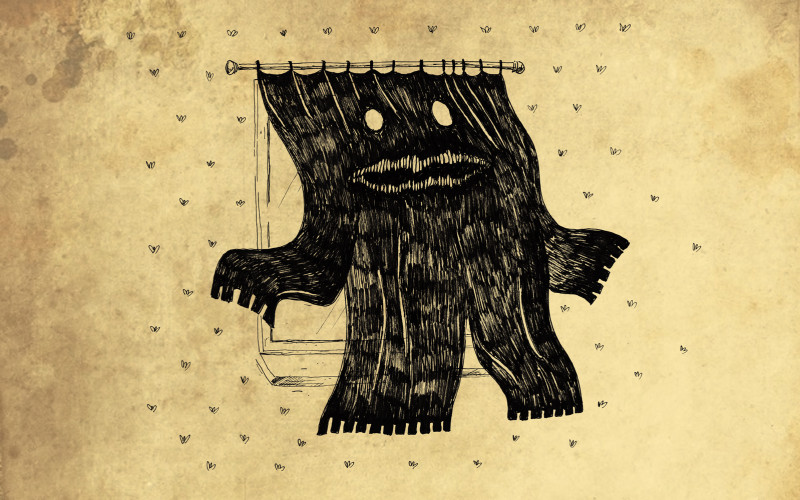
The Black Curtains
Standard apartments of Soviet prefabricated panel housing blocks (Khrushchyovkas and Brezhnevkas, epitomized by the 9th Experimental Block of Novye Cheryomushki in Moscow), state boarding schools, and summer camp dormitories. Within late-Soviet juvenile subculture during the 1970s and 1980s, the lore of the "Black Curtains" crystallized into one of the most pervasive domestic horror tales, transforming a standard household textile into an autonomous nocturnal predator.
The legend
Danger Level: Green (Harmless domestic children's folklore and nocturnal pareidolic illusions posing zero physical danger) The standard narrative follows a rigid formula of taboo violation and retribution: a mother purchases an elegant set of black curtains from a department store, flea market, or mysterious stranger. The vendor issues an ominous command: "Never draw these curtains at night" (or "never leave a child alone behind them"). The parents depart for an evening shift or social gathering, leaving their young daughter unattended. As darkness falls, the child closes the curtains. Suddenly, a droning voice emits from the wall-mounted radio speaker or power outlet: "Girl, girl, the Black Curtains are slipping off the rod... the Black Curtains are on the floor... the Black Curtains are climbing your mattress..." The fabric animates, slithers across the linoleum, rears over the bunk, and envelops the child's mouth and chest like a suffocating shroud to drain blood and life. Returning parents or detectives find an anemic corpse bearing strangle marks; when investigators slash the hanging drapes with shears, arterial blood gushes from the seams or human bones spill onto the carpet.
What actually happened?
The "Black Curtains" cycle has been thoroughly documented by Russian folklorists and developmental psychologists. The narrative is an organic convergence of ocular neurology, child development, and Soviet architectural realities: Nyctophobia and the hostile threshold: To a young child, an unlit window represents an insecure boundary separating the domestic sanctuary from the outside void. A drawn curtain blocks the dark outdoors but inherits its menace, becoming the frontline of the unknown. Drafts leaking through poorly insulated wooden window frames caused heavy fabrics to billow autonomously, while streetlight shadows casting across swinging folds triggered visual pareidolia, mimicking approaching figures. Environmental triggers (particulates and respiratory distress): In Soviet pre-cast concrete apartment blocks, heavy velvet, wool, or brocade drapes were hung out of necessity to seal drafts bleeding through exterior wall joints. These thick textiles acted as massive dust sinks. Sleeping directly beside unwashed drapes exposed children to high concentrations of particulate dust and house dust mites, inducing nocturnal bronchospasms, pediatric asthma attacks, or acute laryngitis ("strangulation by the curtain"). Separation anxiety and parental taboo: The motif of a child abandoned during an evening shift mirrored Soviet latchkey realities and separation anxiety, externalizing the guilt of disobeying parental commands into an aggressive household entity. Formulaic catharsis: The repetitive countdown chant functioned as an emotional stress-inoculation exercise in summer dormitories, ratcheting up group tension before terminating in the teller's physical jump-scare, safely defusing acute childhood fears through communal laughter.
History
Folklore concerning predatory furnishings (curtains, wallpapers, fatal dresses, and woven carpets) emerged across Soviet schools and camps throughout the 1960s and 1970s, propelled by urbanization as millions of families migrated from communal apartments into private microdistrict flats. Unlike rural Slavic tales of forest spirits (leshy) or hearth guardians (domovoy), this subculture was urban, turning the mundane appliances of modernization—wired radios, plastic light switches, and synthetic drapes—into monsters. In the late 1980s, these formulaic tales were collected by academic ethnographers from the Pushkin House of the Soviet Academy of Sciences. In 1990, children's author Eduard Uspensky codified the narrative in the horror novella The Red Hand, the Black Sheet, and the Green Fingers, preserving the curtains in literary memory.
Where is it?
Academichesky District, South-Western Administrative Okrug, Moscow, Russia; centered on the 9th Experimental Quarter of Novye Cheryomushki (bounded by Grimau, Shvernika, and Dmitriya Ulyanova streets)—the birthplace of mass-produced Soviet panel housing, alongside the Folklore Department of the Institute of Russian Literature (Pushkin House) in Saint Petersburg.
Can you visit?
Yes, the 9th Quarter of Novye Cheryomushki in Moscow is a public residential neighborhood freely accessible on foot at any time (served by the Akademicheskaya metro station). It preserves the original late-1950s experimental four- and five-story residential blocks alongside mid-century landscaped courtyards. Authentic ethnographic field transcripts of these juvenile horror stories are cataloged in the academic holdings of Pushkin House in Saint Petersburg, available via research library reading rooms.
The Dybbuk Box
A wine cabinet listed on eBay in 2003 with a long description: supposedly it had belonged to a Holocaust survivor and contained a possessing spirit from Jewish folklore. The lot was resold repeatedly, each owner adding fresh misfortunes to the listing, the auction spread across the internet and eventually became a Hollywood film. In 2021 the original seller, the writer Kevin Mannis, publicly acknowledged that the whole thing was fiction he had written — a literary project that accidentally became a modern legend.

Comments
No comments yet. Be the first.