Inventions — mystical places on the map
Legends whose author is known. Some began on a forum, some in a horror-story contest, some in an advertising campaign — and then went out into the world and acquired eyewitnesses. Marked separately so an invention is not mistaken for something people genuinely believe.
33 places
Polybius: the arcade cabinet that never was
The story says that in 1981 a cabinet called Polybius appeared in the arcades of Portland, Oregon: no manufacturer's name on it, no usual queue — only children who afterwards suffered insomnia, seizures and gaps in their memory, and men in black who came to take readings off the machine. Not one photograph, not one board and not one document exists. The earliest written trace dates not from 1981 but from 2000, a post on an arcade collectors' site written almost twenty years after the "events".
SCP-173: the Foundation's first file
On 22 June 2007 an anonymous user posted a short text to 4chan in the form of a containment report: an object of concrete and rebar that cannot move while it is being looked at, and kills the instant you blink. The entry came with a photograph of Untitled 2004 by the Japanese artist Izumi Katō, used without asking. That single post grew into the SCP Foundation, a collaborative universe of thousands of documents written over years by thousands of people. The illustration was replaced in 2022: the artist had never given permission.
Momo: the sculpture that became a panic
The face that frightened half the world in 2018 and 2019 was never a character. It is Mother Bird, a sculpture by the Japanese artist Keisuke Aisawa of Link Factory, made in the summer of 2016 and exhibited at the Vanilla Gallery in Tokyo. In July 2018 a photograph of it was used in a YouTube video, from there it spread through messaging apps, and by 2019 it had grown into an international panic about a non-existent "challenge" supposedly pushing children towards dangerous tasks. Police forces and child-protection bodies in several countries stated publicly that no confirmed cases were found. The sculpture itself was destroyed by its maker.
The Backrooms: where the photograph was actually taken
The internet's most famous nowhere turned out to be the second floor of a furniture shop in Oshkosh, Wisconsin. The photograph of a yellow corridor under humming strip lights was posted to 4chan on 12 May 2019 in answer to a request for images that felt "a bit off", and the caption underneath it grew into thousands of stories, games and videos about endless empty rooms you fall into by taking a wrong turn. In 2024 internet researchers traced the picture to its source: a 2003 photograph of renovation work on the upper floor of the former Rohner's furniture store, taken for a local hobby shop's website. The building is still standing at 807 Oregon Street, and there is a model shop in it today.
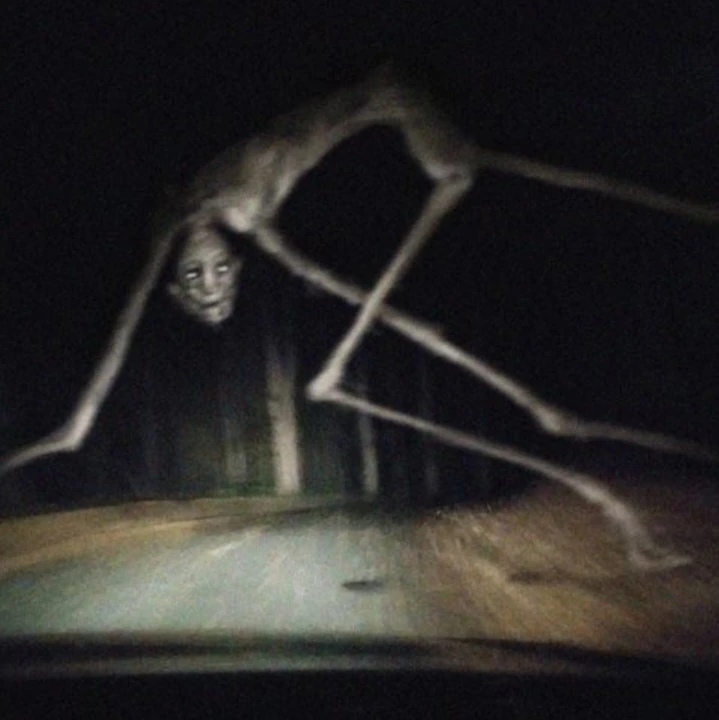
Country Road Creature
Another of Henderson's: a gaunt figure the height of a telegraph pole, caught apparently by accident through a car window on an empty road between fields. Nothing is formally known about it — no habits, no origin, no name beyond the descriptive one. That is the device: the caption under the picture is shorter than a caption normally is, and the rest is left to you.
Bridge Worm
Henderson posted it on 14 August 2019. A long segmented body, apparently assembled from human skulls and vertebrae, wound around the underside of a bridge span. The mechanism is the one all his work uses: the creature does not chase and does not attack, it is simply already there — under a structure you drive over daily and have never once looked beneath.
Long Horse
A rare thing in Henderson's bestiary: a creature that means no harm. A horse's skull on a neck tens of metres long, hanging down from somewhere above. In the mythology that accumulated around it online, Long Horse warns of danger — its appearance is a sign rather than a threat, and the only thing that hurts is the sound it makes, which it cannot help. Of the whole late-2010s internet menagerie it is the one that grew the friendliest fandom.
Cartoon Cat
Henderson drew it in August 2018, days after Siren Head. The creature is done in the visual language of 1930s American animation — rubber-hose limbs, saucer eyes, a permanent grin — but stands two storeys tall and has teeth a cartoon cat should not have. The trick is a single one and it works every time: take an idiom an entire generation associates with safety and childhood, and scale it up until it stops being funny.
Siren Head
A forty-foot figure of rusted metal with two loudspeakers where a head should be. The Canadian illustrator Trevor Henderson posted the first drawing in August 2018 and nothing happened for a year and a half — by his own account it got a couple of likes and was forgotten. It went off in the spring of 2020, when a clip of the thing towering over a city spread everywhere, and within four months it was the most recognisable monster on the internet. Its voice is playback: air-raid sirens, fragments of other people's conversations, calls for help.