Metro-2
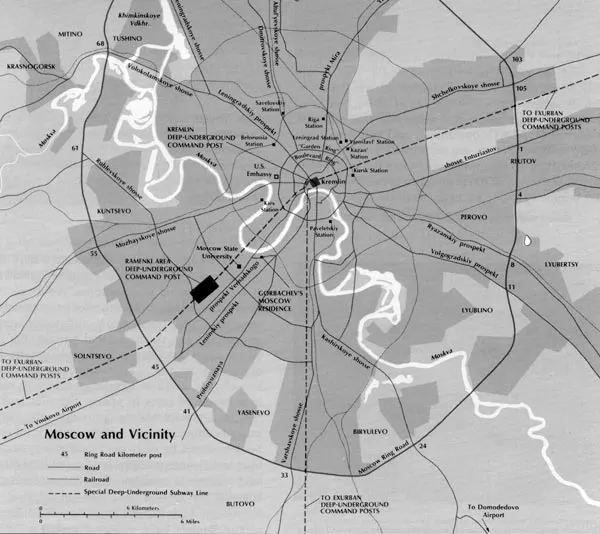
A secret metro line that officially does not exist — Moscow's most durable urban legend. As the story goes, "D-6" links the Kremlin with bunkers, the ministry building on Smolenskaya and Stalin's Near Dacha, and an entrance sits in the basements of Moscow State University's main building, which is said to have as many floors below ground as above. Diggers have published maps for decades that do not agree with one another; the defence ministry has never confirmed anything and never clearly denied it either. The legend runs on that silence: the less that is said, the more detailed the map becomes.
The legend
Urban legends portray "Metro-2" as a colossal subterranean metropolis: multi-tiered highways deeper than 200 meters stretching far into the Moscow countryside and beyond. Folklore claims silent armored trains run along these tracks, that an autonomous underground city capable of sheltering tens of thousands for years lies beneath the Ramenki district, and that abandoned shafts harbor secret genetic laboratories and giant mutant rats.
What actually happened?
Classified transit lines do exist, but their design is strictly utilitarian rather than fantastical. They consist of single-track deep-level tunnels (typically 50 to 120 meters deep) connecting the Kremlin, the Ministry of Defense on the Arbat, Lubyanka, Moscow State University, and major bunker hubs. To minimize fire hazards, the tracks lack a third rail, utilizing battery-electric locomotives and diesel railcars. The system is engineered strictly for rapid tactical transit and emergency evacuation, not sustained underground civilian living.
History
Construction of fortified underground shelters began in the 1930s–1950s under Stalin (including Bunker-42 at Taganka and command posts beneath Stalin's dacha). The bulk of the modern D-6 system was excavated during the Cold War in the 1960s–1980s by Mosmetrostroy under the supervision of the KGB’s 15th Directorate. In the 1990s, high-ranking officials, including former Moscow Mayor Gavriil Popov and presidential advisors, publicly acknowledged the network, cementing it as a cornerstone of post-Soviet urban lore.
Where is it?
The network lies deep beneath Moscow. Documented alignments run beneath the historic city center (the Kremlin, Znamenka, Varvarka, Lubyanka), extending southwest across Sparrow Hills and Ramenki toward the General Staff Academy and onward in the direction of the Vnukovo-2 government airfield.
Can you visit?
No, active lines and stations remain classified state secrets under continuous armed surveillance by the FSO and FSB; trespassing carries severe criminal penalties. However, authentic Cold War underground engineering can be experienced in decommissioned and declassified facilities turned into museums, such as "Bunker-42" in Taganka or "Bunker-703" near Paveletskaya.
The Bloop
In 1997 hydrophones belonging to the US National Oceanic and Atmospheric Administration recorded an ultra-low-frequency sound in the South Pacific loud enough to be picked up by sensors three thousand miles apart. Its profile resembled a biological one, and for two decades the Bloop was the leading exhibit for anyone who believes in undiscovered giants in the ocean. NOAA settled it in 2012: an icequake, an iceberg fracturing off Antarctica. The sound stopped being a mystery but remains one of the best-known audio files in internet history.
Comments
No comments yet. Be the first.