All places
The full catalogue of approved places — abandoned buildings, anomalous zones, UFO sightings. Sort by rating, recency or discussion, and narrow it by category.
494 places
The Davenport Brothers and the Spirit Cabinet
From 1854 Ira and William Davenport of Buffalo toured both sides of the Atlantic with a cabinet in which they were tied up with rope; the doors were shut, and out of the darkness came flying trumpets, ringing guitars and hands at the little window. Nobody could tie them until, in Liverpool in 1868, two sailors used a knot that held: the séance collapsed and the audience wrecked the hall. In 1911 Ira, an old man, received Harry Houdini at home and showed him the method in detail — how the rope is slipped and taken up again — and confirmed that there had never been any spiritualism in the act. Houdini set it down in a book.
Florence Cook and the Spirit Katie King
The London medium Florence Cook would go behind a curtain and Katie King would come out — a full materialisation, photographed and vouched for by the physicist William Crookes. Everyone remarked on the resemblance between the medium and the spirit. In December 1873 William Volckman seized Katie round the waist and held on until confederates pulled her away; when the curtain was opened, Cook lay there with her clothing disarranged. In January 1880, at a sitting in Hackney, Sir George Sitwell caught the spirit Marie and did not let go: it was Cook in her underclothes, and her corset and dress were found in the cabinet. Her career ended there.
Eusapia Palladino at Columbia
For twenty years the Neapolitan medium Eusapia Palladino lifted tables and materialised hands in front of the best scientists in Europe, and some of them went home convinced. Her method never varied: in the dark she substituted one hand or foot for another among the people controlling her, freeing a limb. The Cambridge sittings of 1895 showed it, and the matter was closed in New York in 1910, when investigators from Columbia University hired two conjurors. They took turns lying under the table and watched, in the dark, her foot come out of its shoe and brace against the leg. The report was printed in full and the American tour ended there.
Margery and the Scientific American Prize
Mina Crandon, the wife of a Boston surgeon and known as Margery, was the leading claimant for the $2,500 Scientific American had offered for a genuine mediumistic phenomenon. Harry Houdini sat on the committee; he built a wooden cabinet that closed around her to the shoulders, and after the sittings stated that she produced everything with her head and a foot, ringing the bell box with her knee. Her dead brother Walter left a thumbprint in wax, and that was held to be conclusive — until 1932, when the print was identified as that of the Crandons' living dentist, Frederick Caldwell, who had once shown her how an impression is taken. The prize was never awarded.
Helen Duncan and the Last Witchcraft Trial
The Scottish medium Helen Duncan produced ectoplasm from her mouth, out of which the shapes of the dead were formed. In 1931 Harry Price obtained a sample after a London sitting: cheesecloth stitched to paper and stiffened with egg white. On 19 January 1944 police arrested her in the middle of a séance in Portsmouth — above the naval port preparing for the Normandy landings, where she had been telling relatives that a ship was lost before the Admiralty said so. She was tried at the Old Bailey under the Witchcraft Act of 1735, for pretending to call up spirits, and given nine months. It was the last conviction under that Act in British history; the Act itself was repealed in 1951.
The Hexham Heads
In February 1971 two boys digging a garden behind a house on Rede Avenue in Hexham turned up two small stone heads. A neighbour soon reported seeing a half-man, half-wolf at night, the researcher Anne Ross said the same creature had appeared to her in her own house in Southampton, and the heads were declared Celtic and eighteen hundred years old. Then Desmond Craigie, a previous occupant of the house, came forward: he had made them in 1956 for his daughter Nancy, out of concrete and sand. To prove it he made a third in front of witnesses, indistinguishable from the others. Geologists confirmed the material was cast concrete with quartz sand, not carved stone.
Gef, the Talking Mongoose of Dalby
From 1931 the Irving family lived at the lonely farm of Cashen's Gap above Dalby on the Isle of Man with a creature that called itself Gef: not a spirit, an earthbound animal with clever hands, the eighth wonder of the world. It spoke from behind the wooden panelling, knew the gossip of neighbouring villages, sang and threw stones. Harry Price and Richard Lambert came and never saw Gef, but they were given tufts of his fur. Julian Huxley passed them to the Zoological Society, where F. Martin Duncan reported that the hair was a dog's — almost certainly the Irvings' sheepdog Mona. The voice, by every account of it, belonged to the farmer's daughter Voirrey.
The Columbus Poltergeist
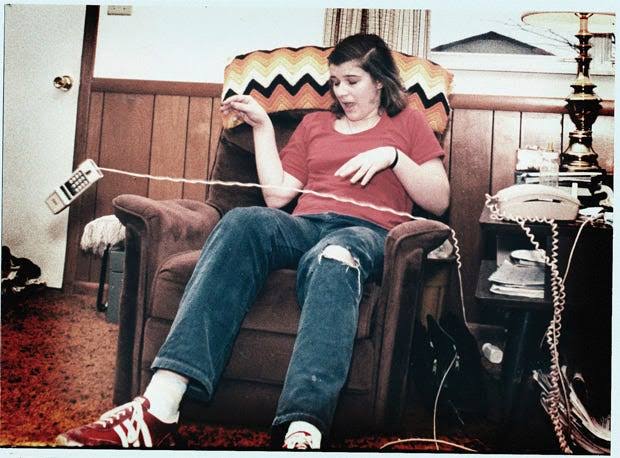
A modest single-story suburban residence located at 3496 Broadmoor Avenue in East Columbus, Ohio, United States. In March 1984, this typical home of adoptive parents John and Joan Resch became the epicenter of an international media storm regarding a sequence of alleged psychokinetic disturbances known as the "Columbus Poltergeist" (or the "Tina Resch case"), emerging as one of the most celebrated and thoroughly debunked episodes in the history of paranormal research.
Brookfield: The Devil Made Me Do It
On 16 February 1981 in Brookfield, nineteen-year-old Arne Cheyenne Johnson stabbed his landlord Alan Bono to death. The defence, supported by Ed and Lorraine Warren, argued that Johnson was possessed by a demon passed to him from eleven-year-old David Glatzel — the first attempt in American legal history to enter possession as a defence. Judge Robert Callahan refused to admit it: it cannot be proved and the law has no such ground. Johnson was convicted of manslaughter. The boy's older brother Carl Glatzel later sued the Warrens, calling the whole affair an invention got up for a book contract.
The Snedeker House at Southington
In 1986 the Snedeker family rented half a house on Meriden Avenue in Southington and found the remains of a funeral parlour in the basement: a coffin lift, drainage channels, a box of photographs of the dead. After that, according to a book and two films, came the demons. The book was written by Ray Garton, and Garton himself described how it ended: the family's accounts contradicted one another, and Ed Warren told him to make things up and make them scary — they were all crazy, he could put it together however he liked. Neighbours and the landlord told reporters that nothing had happened during the tenancy at all.
The Hammersmith Ghost and the Smith Case
Through the winter of 1803–04 a figure in white went about Hammersmith throwing itself at passers-by; it was said to be a suicide from the churchyard. The parish organised night patrols, and in the early hours of 3 January 1804 the excise officer Francis Smith fired at a white shape in Black Lion Lane and killed Thomas Millwood, a bricklayer walking home in the white linen of his trade. Smith was sentenced to death for murder, commuted to a year's hard labour, and the case served English law for two centuries as the standard problem of whether an honest mistake can excuse force. The ghost itself was accounted for soon afterwards by a shoemaker, John Graham, who admitted wrapping himself in a sheet to frighten his apprentice.
The Stockwell Ghost
On 6 January 1772, in Mrs Golding's house at Stockwell, china began to come off the shelves, clocks fell from the walls and a ham stepped off its hook. She fled to the neighbours and it all happened again there. The two houses had one thing in common: her twenty-year-old maid Ann Robinson went with her. The maid was dismissed and the destruction stopped at once. Years later Robinson told the clergyman Samuel Horsley how it was done — horsehair tied to the crockery, wire, fixings filed through in advance, and a careful sense of when to leave the room. She had wanted the house empty so that her young man could visit.
The Cock Lane Ghost
In the winter of 1762 a house on Cock Lane near Newgate was knocked on by the ghost of Fanny Lynes, a young woman who had died and who now accused her own lover, in raps, of poisoning her. London lost its head: carriages blocked the street, money was taken at the bedroom door, the affair was discussed in Parliament. A commission that included Samuel Johnson spent a night in the vault of St John's and summoned the ghost to the coffin, where nothing happened. Eleven-year-old Elizabeth Parsons was then put in a hammock with her hands tied and the knocking stopped; watched closely, she was found with a small board hidden on her. Her father Richard Parsons was sentenced to two years and stood three times in the pillory.
Hydesville and the Fox Sisters' Rappings
In March 1848, in a rented house at Hydesville, the sisters Margaret and Kate Fox, fourteen and eleven, began answering a murdered pedlar in raps: one for yes, two for no. Neighbours came in crowds, their older sister Leah took them to Rochester and sold tickets, and out of that room grew the whole of American Spiritualism. On 21 October 1888 Margaret walked onto the stage of the New York Academy of Music and, before a full house, showed how it was done: she cracked the joint of her big toe, and the sound carried through the boards as though the walls were knocking. Kate sat in a box and nodded. A year later Margaret retracted the confession, badly in need of money, but the doctors who examined her foot on that stage had already confirmed the mechanism.
The Lake George Monster
In the summer of 1904 a green horned head began surfacing beside boats on Lake George in upstate New York. The painter Harry Watrous, who lived at Hague, had made it from a log: painted, with tin teeth and glass eyes, sunk on a rope and pulley so it could be raised at the right moment — the joke was aimed at his friend and fishing rival William Mann, who had been boasting of his catches. Watrous admitted it the same year, once the joke escaped their circle. The log survives: since 1934 the Hague Chamber of Commerce has displayed Harry the Hoax at the local museum on the shore of the same lake.
De Loys's Ape
In 1920 the Swiss geologist François de Loys, prospecting for oil on the Venezuela–Colombia border, shot what he described as a large tailless ape that came at his party by the Tarra river. The single photograph — the animal propped on a crate with a stick — was published in 1929 by George Montandon as Ameranthropoides loysi, the missing link of American man; Montandon used it in a racist theory of the separate origin of races. The picture shows an ordinary white-fronted spider monkey, common in those forests: the crate gives a true height of about a metre, and the tail is hidden behind the body. De Loys's companion later said the whole thing had been a joke at Montandon's expense.
Canóvanas and the Chupacabra from the Cinema
In the spring of 1995 drained goats began turning up in the Puerto Rican town of Canóvanas, and Madelyne Tolentino described the thing she had seen through her window: about four feet tall, huge black almond eyes, a ridge of spines down its back, thin arms. The world's entire image of the chupacabra comes from that description. The investigator Benjamin Radford tracked her down in 2010 and established that a few weeks earlier she had seen the film Species, in which the alien Sil looks exactly like that. The animal carcasses, when vets opened them, had been killed by dogs and coyotes, and still had their blood.
Bluff Creek and Wallace's Wooden Feet
In August 1958 the bulldozer operator Jerry Crew brought a plaster cast of a sixteen-inch footprint into the office of the Humboldt Times, taken from a logging road at Bluff Creek in northern California. The headline coined the word Bigfoot and the story went national — this is where the creature got its name. The contractor on that road was Ray Wallace. After he died in 2002 his family showed reporters a pair of feet carved from alder that he had used to make the prints, and said he had been doing it from the start. His son put it plainly: the reality is, there is no Bigfoot.
Liaoning and the Piltdown Bird
In November 1999 National Geographic held a press conference for Archaeoraptor liaoningensis, the missing link between dinosaurs and birds, bought at a mineral fair in Arizona for eighty thousand dollars and quarried from the shales of Liaoning. The Chinese palaeontologist Xu Xing saw the article and recognised the tail: he had described it himself, and it belonged to a Microraptor. CT scanning confirmed the slab was glued together from at least two and probably five animals — the body of the bird Yanornis, the tail of a Microraptor. The magazine retracted, and the specimen went into the textbooks as the Piltdown Bird.
Thetis Lake and the Creature from the Black Lagoon
On 19 August 1972 two teenagers ran to the police in Victoria, British Columbia, to report that a scaled creature with a crest on its head had come out of Thetis Lake and cut one of them on the arm. The description was almost word for word the monster from Creature from the Black Lagoon. Days later a man came forward whose pet tegu lizard had escaped, and the police closed the file; shortly afterwards one of the boys admitted to the RCMP that they had made the whole thing up. The monster is still on the lists of Canadian cryptids.
Silver Lake and the Canvas Serpent
In the summer of 1855 a sea serpent began to be seen in Silver Lake beside the village of Perry, New York. The papers took it up, excursion trains ran from Buffalo and Rochester, and the Walker House hotel was full for two seasons. In 1857 the hotel burned down, and in the attic the firemen found what was left: a frame of wire and whalebone covered in canvas, with a system of ropes and a blacksmith's bellows to raise the monster off the bottom and make it breathe smoke. The proprietor, Artemus Walker, had already left town.
Philadelphia and the Kangaroo with Bronze Wings
For a week in January 1909 southern New Jersey and Philadelphia lived in a panic: thousands reported tracks in the snow and a flying creature, schools closed, factories sent workers home. In the middle of it Norman Jefferies, publicity agent for Philadelphia's Arcade Museum, announced that the Jersey Devil had been captured. In the case sat a kangaroo he had bought, with bronze wings fastened to its back, and a man poking the cage to keep it moving. Jefferies admitted it himself years later — along with the fact that some of that week's eyewitness reports had also been his work.
Khumjung and the Yeti Scalp
The conical russet scalp in the monastery at Khumjung was held by the Sherpas to have been taken from a yeti and kept as a relic. In 1960 Edmund Hillary's expedition was allowed to take it to Chicago, Paris and London for examination, against a deposit and in the company of a village elder. The verdict was unanimous: the scalp had been moulded from the hide of a serow, a goat-antelope common in the same mountains, and the direction of hair growth and the structure of the skin matched exactly. It was returned to Khumjung, where it still is.
Pangboche and the Yeti Hand
The monastery at Pangboche in the Khumbu kept a hand for centuries that the monks called a yeti's. In 1959 the expedition member Peter Byrne swapped several bones for human ones and smuggled the originals out — in the luggage of the actor James Stewart, by the usual telling. Tests over the years contradicted one another until 2011, when the University of Edinburgh sequenced what survived: human bone. The relic itself was stolen from the monastery in the nineties, and what remains of it is an ordinary human hand with somebody else's fingers attached.